TRAVELER STORY · 충북
Written by AI from Korea Tourism Organization travel-course data. It is not a real visitor’s review, so check hours and travel times before you go.
A first journey into Danyang unfolds through cliffs, river light, and the old landscapes that once captivated Korea’s painters.
In Danyang, the river does not simply pass through the mountains; it teaches them how to become scenery.
The first thing I noticed in Danyang was the way the air felt rinsed clean, as if the mountains had filtered every breath before it reached me. I came here because the name Danyang Palgyeong, the Eight Scenic Views of Danyang, kept appearing whenever Koreans spoke about classic natural beauty. This was not a place built around a single landmark. It was a sequence of scenes, a journey made of water, stone, and changing light.
There is a weight of history here, but it never feels dusty. Artists such as Kim Hong-do, one of Korea’s best-known painters of the Joseon era, once turned these views into images that outlived their century. Standing at the start of my route, I understood why. Danyang does not ask for interpretation. It overwhelms first, then lingers.
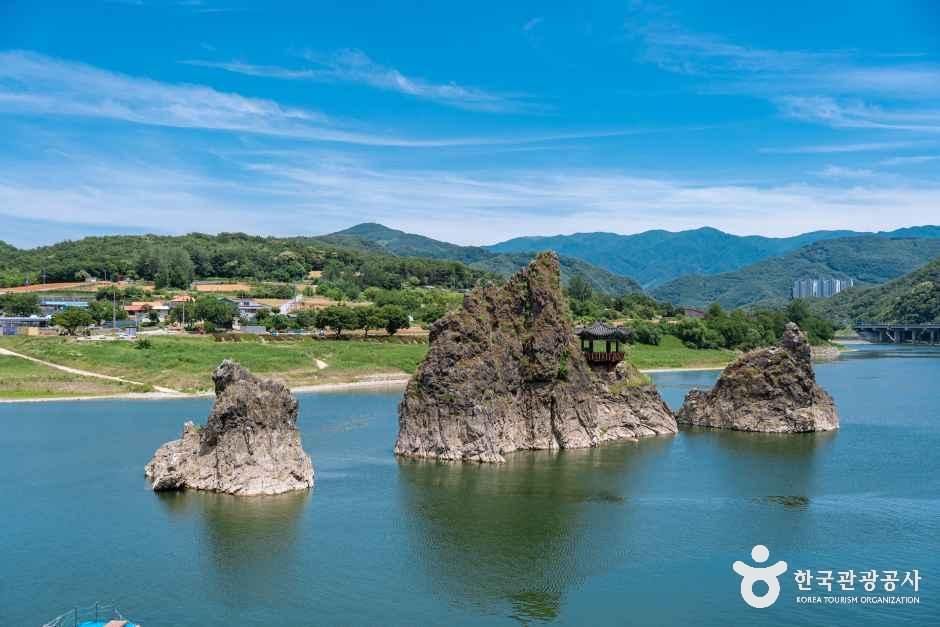
Sunlight spilled across the river in sheets of silver when I reached Dodamsambong, three rock peaks rising dramatically from the water. The scene had a calm theatricality to it: the river barely moving, the peaks standing in perfect balance, the surrounding hills holding everything in a soft green frame. I could see why scholars and painters returned to this view again and again. It felt composed, almost impossibly so, yet completely natural.
I wandered slowly through the riverside area, then stepped into the Sam Bong Story Hall, a small space that adds context to the landscapes outside. Instead of interrupting the experience, it sharpened it. Back by the water, the hwangpo-dotbae, a traditional yellow-sailed boat, moved across the river toward Dodam Garden, passing Seokmun, a striking rock arch. From the opposite side, the view opened wider, and the peaks seemed less like an attraction than the center of an old river kingdom.
Dodamsambong is one of the signature views of Danyang Palgyeong, where three sharp rock peaks rise straight from the river in a composition that once captivated painters such as Toegye Yi Hwang, Gyeomjae Jeong Seon, and Danwon Kim Hongdo. Inside the riverside grounds, the Sambong Story Hall introduces Danyang's scenic heritage, while the hwangpo-dotbae, a traditional yellow-sail boat, carries visitors past Seokmun to the garden across the water.
The scene feels composed and theatrical: calm water, steep stone, and open sky meeting in one clean frame. Even with other visitors around, the river gives the place a slow, spacious rhythm.
Start with the main riverside viewpoint for the classic three-peak panorama, then step into the Sambong Story Hall for context before boarding the hwangpo-dotbae if the weather allows. The boat route passes Seokmun and reaches Dodam Garden, known for its yellow cosmos fields, so it is worth planning as part of the same stop.
Gudambong and Oksunbong stand among the most celebrated scenes of Danyang Palgyeong, where sheer rock walls rise above the water with theatrical force. Gudambong takes its name from cliffs reflected in the lake like a turtle's shell, while Oksunbong lifts pale blue-white stone spires skyward like fresh bamboo shoots.
The landscape feels both grand and strangely calm, with lake light softening the harsh geometry of the cliffs. In autumn, the ridgelines burn with color and the whole view turns painterly.
The clearest way to appreciate both peaks is from a Chungjuho Lake cruise or sightseeing boat, where the full rock faces open up at once. Autumn foliage is the signature season here, and the approach along Route 36 from Danyang is part of the experience.
단양 구담봉·옥순봉은 충주호 물길과 바위 봉우리가 함께 만드는 단양팔경의 절경지입니다. 구담봉은 강물에 비친 기암절벽이 거북 등껍질처럼 보인다 해서 이름 붙었고, 옥순봉은 희고 푸른 바위가 대나무 순처럼 솟은 모습이 인상적입니다.
물 위에서 바라보면 절벽의 결이 가까워졌다 멀어지고, 봉우리 그림자가 호수에 겹쳐 한 폭의 산수화 같은 장면이 이어집니다. 가을에는 단풍빛이 바위 틈과 물가를 따라 번져 계절감이 더 짙게 남습니다.
구담봉과 옥순봉은 충주호 유람선이나 관광선을 타고 보는 방법이 가장 확실하게 즐기는 동선으로 알려져 있습니다. 단양읍에서 구담봉으로 향하는 36번 국도도 대한민국 아름다운 도로 100선에 꼽힌 길이라 이동 중 풍경까지 함께 챙겨볼 만합니다.
Sainam Rock is one of Danyang Palgyeong, the Eight Scenic Views of Danyang, where a 70-meter cliff rises dramatically beside the clear stream of Namjocheon. Its broad granite wall, shaped by striking vertical and sheet-like joints, creates a severe, beautiful landscape where geology, history, and riverside scenery meet.
The place feels both majestic and cool, with sheer rock, running water, and deep green valleys holding the scene in a tense quiet. It is the kind of landscape that makes you stop walking and simply stare upward.
Walk along the stream first to take in the full cliff face, then look for the details in the rock surface and erosion features near the water. The nearby Cheongnyeonam Hermitage and the Seonamgol Ecological Trail add cultural and trekking appeal to the visit.
The sound reached me before the cliff did: fast water slipping over stone, echoing lightly through the valley. Then Sainam appeared, a towering granite wall rising about 70 meters above the clear stream of Namjocheon. The rock face looked almost architectural, like a screen set upright by some ancient force, its vertical lines so clean they seemed carved rather than formed.
What stayed with me was the tension between softness and severity. The stream below was cool, green, and inviting; the cliff above was stern and monumental. Erosion had left its marks in the riverbed, and the whole place carried the kind of geological drama that makes you instinctively lower your voice. I stood there longer than I expected, tracing the meeting point between water and stone, and felt the scale of Danyang in a more intimate way. This was not the broad panorama of a postcard. It was texture, depth, and silence.
The road toward Gudambong and Oksunbong was part of the pleasure. Route 36 unfurled beside the landscape with long, elegant curves, each bend revealing another cut of river, another shoulder of mountain. Even from the drive, I could sense why this corridor is praised as one of Korea’s beautiful roads. The journey kept gathering momentum, as if the scenery were preparing me for a final reveal.
Gudambong rose with a rugged grace, its rocky form reflected in the water below. The name comes from the resemblance to a turtle floating in the lake, and once I heard that, I could not unsee it. Then came Oksunbong, a peak whose sharp lines and commanding presence gave the landscape its final flourish. By then the day had shifted into that golden, late-afternoon clarity that makes cliffs glow from within. I remember thinking that Danyang’s beauty is not gentle. It is precise, sculptural, and deeply cinematic.
As I left, the images began to merge: Dodamsambong in morning light, the cool stone shadow of Sainam, the proud silhouettes of Gudambong and Oksunbong. The Eight Scenic Views are often described as must-sees, but that phrase feels too small. What Danyang offers is not a checklist. It is a progression, each scene teaching you how to look more carefully at the next.
Long after I left Danyang, I kept returning to the contrast that defines it: still water and sheer rock, grand panoramas and quiet detail. It felt less like visiting a destination than stepping, for a day, into a living landscape painting.
Travel tips
Walk this story
Places in this story
4 places
Itinerary
1 day
Region
충북
Places you can import
4 places

Comments
See what other travelers are saying.
Sign in to leave a comment
You can sign in with Google, Kakao or Naver.