TRAVELER STORY · 충북
Written by AI from Korea Tourism Organization travel-course data. It is not a real visitor’s review, so check hours and travel times before you go.
A forest-and-river walk through Hwayang Gugok and the restored mountain path of Sanmagi Yetgil.
In Goesan, water does not simply pass through the valley; it lingers on stone, catches the light, and teaches you how to slow down.
The first thing I remember is the sound. Water slipping over broad sheets of rock, steady and silver, with the forest holding the whole valley in a hush that felt almost ceremonial. I came to Goesan for a day of walking, expecting scenery. What I found instead was a landscape that seemed to breathe in long, patient rhythms.
Hwayang Gugok is not one single viewpoint but a sequence of encounters, a valley unfolding curve by curve. This stretch of stream is famous for its nine scenic bends, and once I understood that, I stopped trying to rush ahead. I let the place reveal itself slowly: pale stone under clear water, deep green trees crowding the banks, and pools so still they looked polished.
There is cultural memory here too. The valley was named in the Joseon era by the scholar Song Si-yeol, inspired by the famed Nine Bends of Wuyi in China, and that old ideal of landscape as poetry still makes sense when you stand beside the water. It is easy to imagine why someone would stay here long enough to turn scenery into language.
Hwayang Gugok is a nine-scenery valley in Goesan where clear water slides over broad rock slabs and dense forest closes in around the stream. The route stretches 3.1 km from Gyeongcheonbyeok, a dramatic cliff at the first scene, to Pacheon, a wide white-rock reach at the ninth. It is also tied to Song Si-yeol, a mid-Joseon scholar who stayed here and shaped the valley's identity after China's Wuyi Nine Bends.
The valley feels cool, lucid, and quietly theatrical, with jade-toned pools, carved rock faces, and the sound of water moving over stone. Even when the landscape turns grand, the mood stays contemplative, as if the place still invites a line of poetry before the next bend.
Follow the valley from the 1st scene to the 9th, watching for Unyeongdam, a clear pool, Eupgungam, a historic rock ledge, Geumsadam, a sandy stream basin, and Pacheon, where water runs across broad pale stone like scales laid in a row. The route is open year-round, has rest areas along the way, and can also be enjoyed by car, but the road must be taken one way from the 1st scene entrance toward the 9th.
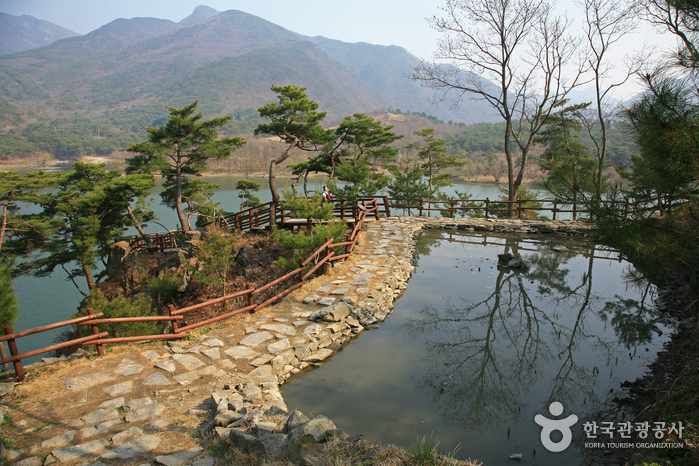
산막이옛길은 충북 괴산군 칠성면 외사리 사오랑 마을에서 산골 마을인 산막이 마을까지 연결됐던 옛길로서 흔적처럼 남아있는 옛길에 덧그림을 그리듯 그대로 복원된 산책로이다.
Sunlight flashed across the stream at Gyeongcheonbyeok, the first bend, and everything after that felt like a quiet progression into deeper beauty. The rocks were immense, smoothed by centuries of current, and the water spread over them in clear ribbons. It was the kind of place that makes you instinctively lower your voice.
As I moved farther in, the details became the memory. At Unyeongdam, a jade-toned pool, clouds seemed to rest on the surface. At Eupgungam, the rounded hollows in the rock looked almost designed, though water had done the carving. Near Geumsadam, where traces of Song Si-yeol's legacy remain, the valley briefly shifted from wilderness to something more reflective, a reminder that Korean landscapes are often read not only with the eyes but with history in mind.
What stayed with me most was the texture of the place. Cool spray on my arms. The rough warmth of sunlit rock under my palm. The resinous scent of trees heating up as the morning turned toward noon. It felt less like sightseeing and more like being absorbed into the valley's tempo.
By the time I reached Sanmagi Yetgil, the mood changed from river reverie to forward motion. The path, once the old route linking a remote mountain village, has been restored without losing its sense of having belonged to ordinary footsteps long before visitors arrived. Boardwalk sections carry you through the landscape lightly, keeping the terrain intact while giving you wide, cinematic views.
Here the beauty comes in layers: mountain slopes folding into the distance, forest pressing close on one side, and the calm water near Goesan Dam opening up on the other. The trail feels thoughtfully made, but never overdesigned. It still lets the wind through the pines do most of the talking.
I paused at overlooks more often than I expected. A suspension bridge strung between pines. Rest spots that seem placed exactly where your legs begin to ask for them. The lake catching the sky in long blue strips. What makes Sanmagi Yetgil special is not a single dramatic moment but the way mountain, water, and forest keep rebalancing the scene as you walk.
Late in the day, the trail and the valley began to merge in my mind. One had the polished grace of water and stone; the other carried the faint imprint of old village life and mountain passage. Together they made Goesan feel complete, not just beautiful but lived in, shaped by people who knew how to move through nature without overpowering it.
I left with tired legs and the kind of calm that is hard to manufacture back in a city. What lingered was not just the scenery, but the order of it: rock, stream, pine, distance, silence. Some trips give you landmarks. This one gave me a rhythm, and I have been replaying it ever since.
Goesan stayed with me as a place of clear water, long shade, and unforced beauty. It felt like stepping into a landscape that asks for nothing except your full attention.
Travel tips
Walk this story
Places in this story
2 places
Itinerary
1 day
Region
충북
Places you can import
2 places

Comments
See what other travelers are saying.
Sign in to leave a comment
You can sign in with Google, Kakao or Naver.