TRAVELER STORY · 경기
Written by AI from Korea Tourism Organization travel-course data. It is not a real visitor’s review, so check hours and travel times before you go.
A day of ruins, royal memory, and museum halls that turns Yeoju into one long conversation with Korea’s past.
In Yeoju, history does not sit behind glass. It lingers in the wind over ruined stone, in temple paths by the river, and in the quiet rooms where a nation’s story once began.
The first thing I noticed in Yeoju was the stillness. Beyond the wider geography of central Korea, where the city sits between places like Wonju, Chungju, Icheon, and Yangpyeong-gun, the landscape here feels less like a crossroads and more like a pause. That mood settled over me at Yeoju Godal-saji, the temple site of the former Godal-sa, where broken stone and open ground carry the weight of centuries with surprising grace.
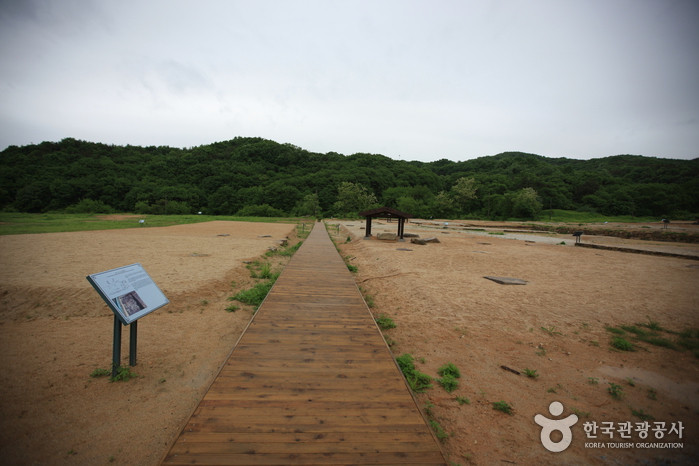
Set against the slopes of Hyemoksan, Godal-saji does not announce itself with grandeur. It draws you in slowly. This was once a major temple founded in 764, rebuilt and expanded through the late Silla and Goryeo periods, powerful enough to be counted among the great monasteries of its age. Standing there now, with grass moving around old foundations and carved relics exposed to the sky, I felt the particular thrill of Korean historical sites: not polished spectacle, but endurance. The silence seemed earned.
Yeoju Godal-sa Site is the open-air remnant of a once-massive Buddhist temple founded in 764, spread across the foothills of Hyemoksan Mountain. The grounds still hold a remarkable concentration of stone relics, including a national treasure and several designated treasures, giving travelers a vivid sense of the temple's former scale and authority.
The site feels spacious, wind-worn, and quietly monumental, as if the mountain has been keeping the memory of the temple for centuries. Broken history and refined stonework stand together here, creating a mood that is both solemn and surprisingly alive.
Walk slowly between the great stone pedestal, the Wonjongdaesa stele, and the elegant stupas to appreciate how much of the temple's force still survives in stone. The nearby Goryeo stone chamber tomb behind the stupas is also worth seeing, and the site is open year-round with free access implied by the always-open format.
신륵사는 봉미산 기슭과 남한강 물길이 맞닿는 자리에 선 여주의 대표 사찰입니다. 산속 깊은 절과 달리 강변으로 열린 풍경이 먼저 들어오고, 고려 말 나옹선사의 흔적과 벽돌로 쌓은 다층전탑이 이곳의 긴 시간을 짐작하게 합니다.
경내를 걷다 보면 전각의 처마 너머로 강물이 비치고, 바람에 흔들리는 나뭇잎 소리가 오래된 석탑의 질감과 겹칩니다. 역사 유적을 둘러본다는 느낌보다 강가에 놓인 시간 속으로 들어가는 감각에 가깝습니다.
강변 쪽 동선과 다층전탑을 함께 보면 신륵사가 왜 ‘벽절’로도 불렸는지 더 선명하게 다가옵니다. 주변에 여주도자세상과 황포돛배 유람선, 식당가가 가까워 여주 역사탐방 코스 중간에 들르기 좋고 화장실도 이용할 수 있습니다.
Inside Yeoju Museum, the air shifted from wind and dust to cool quiet, the kind that makes you lower your voice without thinking. After the sparse poetry of the ruins, the museum offered something different: context, texture, and the chance to understand how Yeoju became more than a dot on the map.
Opened in 1997 and expanded over time, the museum gathers local history, folk materials, and excavated artifacts that once lay scattered far from their place of origin. The permanent galleries unfold across four themes, while planned exhibitions and outdoor displays deepen the picture. I liked the way the museum bridged everyday life and dynastic history. You move from objects that speak of ritual and power to materials shaped by ordinary hands, and suddenly the region feels inhabited across time, not just remembered.
Because admission is free, it is easy to enter on impulse, but it rewards a slower visit. Go after seeing Godal-saji if you can. The ruins sharpen your curiosity; the museum answers it.
Yeoju Museum is the place where Yeoju's long timeline comes into focus, from prehistoric relics and Buddhist heritage to royal tomb culture and modern literary history. Opened in 1997 and expanded over the years, it now brings together permanent, special, and outdoor exhibitions that trace the city's identity with unusual breadth.
The museum feels calm and deliberate, with each gallery shifting the mood from excavated history to river-worn stone art and the measured dignity of royal memory. Even outdoors, the setting keeps the experience grounded in Yeoju's landscape rather than sealed away from it.
Start with the Yeoju History Hall for the clearest overview, then move through the Namhangang Stone Exhibition Hall and the Joseon Royal Tomb Hall to see how local history, nature, and royal legacy connect. Admission is free, so it works well as an easy stop on a wider Yeoju history route that also includes Silleuksa Temple and the royal tombs.
Myeongseonghwanghu Saengga, the birthplace and early childhood home of Empress Myeongseong, holds one of Yeoju's most personal links to late Joseon history. The surviving inner quarters date back to 1687, while the restored outer buildings, nearby Gamgodang, the memorial hall, and the arts hall help visitors trace the life, politics, and legacy of a woman who stood at the center of a turbulent era.
The site feels quiet and reflective, with old wooden structures, open yard space, and the weight of royal history lingering in the air. It is less grand than a palace, but more intimate, as if history has been folded into an ordinary domestic scene.
Walk first through the restored house compound, then continue to Gamgodang and the memorial hall to follow the arc from childhood home to royal life. Parking and restrooms are available, and this stop fits naturally into a Yeoju history route linking King Sejong's Tomb, Silleuksa Temple, and other heritage sites.
The creak of wooden floors at Myeongseong Hwanghu Saengga, the birthplace of Empress Myeongseong, stayed with me longer than I expected. The house itself is not overwhelming in scale. That is exactly why it works. You enter expecting a historical residence and leave thinking about the child who lived here before politics, court ceremony, and violence remade her life.
This is where Empress Myeongseong, consort of King Gojong of the Joseon dynasty, spent her earliest years. For travelers unfamiliar with Korean history, she is one of the most consequential and tragic royal figures in the country’s modern story, a political partner in an era of reform who was assassinated in 1895 during a period of intense foreign intervention. Knowing that, the surviving inner quarters feel almost startlingly intimate. The site folds national history into domestic space: wooden beams, courtyard light, and rooms that once belonged to a family before they belonged to memory.
The house was first built in 1687, and although later restoration rebuilt parts of the compound, the surviving core preserves that sense of age. I visited in the late afternoon, when the light softened across the eaves, and it was the most human moment of the trip. Not the rise and fall of kingdoms, but the beginning of a life.
By the end of the day, Yeoju no longer felt like a checklist of historical stops. It felt layered. Even without rushing to summarize every dynasty and date, I could sense how this part of Gyeonggi-do holds together Korea’s religious, royal, and local histories in one compact journey.
What I carried away was not only information, but atmosphere: the open sky above Godal-saji, the measured calm of Yeoju Museum, the hush of Empress Myeongseong’s birthplace. Yeoju gives history room to breathe. Instead of staging the past as something distant, it lets you walk beside it for a while, and that is what makes the experience linger.
Yeoju left me with the feeling that history is not always monumental; sometimes it is quiet, weathered, and deeply personal. Long after I left, I could still picture those stones, those rooms, and the hush between them.
Travel tips
Walk this story
Places in this story
4 places
Itinerary
1 day
Region
경기
Places you can import
4 places

Comments
See what other travelers are saying.
Sign in to leave a comment
You can sign in with Google, Kakao or Naver.