TRAVELER STORY · 전남
Written by AI from Korea Tourism Organization travel-course data. It is not a real visitor’s review, so check hours and travel times before you go.
In Haenam, a storied temple and a wind-brushed ridge reveal one of South Korea’s most quietly powerful landscapes.
On the southern edge of the peninsula, Durunsan feels less like a mountain you conquer than a sanctuary that slowly gathers you in.
The air changed first. It grew softer, greener, almost marine, as I made my way toward Haenam at the southern end of the Korean Peninsula. Durunsan rose ahead in layered folds, less dramatic than some of Korea’s famous peaks at first glance, but with a gravity that pulled me in. This was not a place built for spectacle alone. It carried the weight of memory.
I had come for Daeheungsa, a Buddhist temple folded into the mountain, long regarded as a place of refuge. The old belief that disasters could not easily touch this valley still lingers in the atmosphere, and once I stepped beneath the trees, that idea did not feel like mythology so much as mood. The path quieted me before I had even reached the first gate.
두륜산도립공원은 대흥사를 품고 8개의 암봉이 능선을 이루는 해남의 큰 산자락입니다. 난대성 상록활엽수와 온대성 낙엽 활엽수가 섞인 숲길을 따라 걷다 보면, 계곡과 사찰, 케이블카와 전망대까지 한 흐름으로 이어집니다.
장춘동계곡 쪽으로 들어서면 물소리와 나무 그늘이 먼저 따라붙고, 봉우리들은 멀리서도 둥글게 산세를 감싸는 듯 보입니다. 대흥사로 향하는 길에는 오래된 사찰의 기운과 남도 산림의 짙은 초록이 함께 남습니다.
대흥사, 미로파크, 두륜산 케이블카, 쉼터를 함께 둘러볼 수 있으며 정상부에서는 서해안과 남해안의 다도해 풍경을 내려다볼 수 있습니다. 가을 단풍과 동백나무, 억새밭이 계절마다 다른 표정을 만들어 산행 동선에 여운을 더합니다.
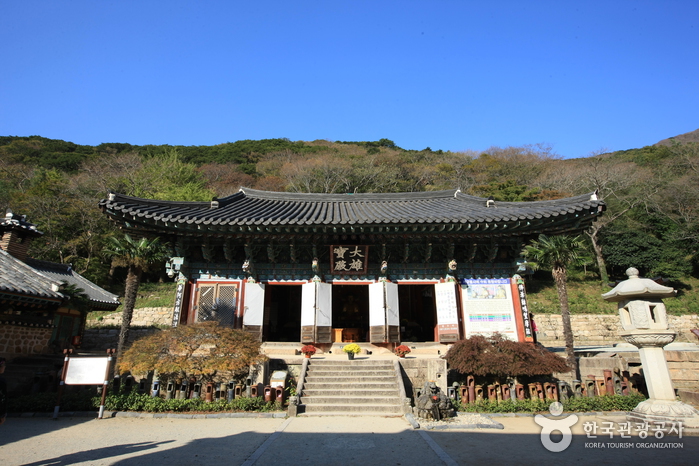
Daeheungsa, a historic Buddhist temple on the slopes of Duryunsan in Haenam, is said to have been founded in the 22nd year of King Seong of Baekje. In 2018, it was inscribed on the UNESCO World Heritage list as part of the Sansa, Buddhist Mountain Monasteries in Korea, and its grounds hold layers of military, spiritual, and tea-culture history.
The temple feels deep-rooted and unhurried, with mountain air, old stone paths, and a calm that seems to settle in before you notice it. Even with its grand history, the mood is quiet rather than dramatic, as if the valley is still protecting centuries of prayer and retreat.
Walk slowly through the outdoor temple grounds and look for the traces that connect Daeheungsa to Seosan-daesa, the monk militia of the Imjin War, and the tea legacy of Choui Seonsa. Admission is free, and the site is well suited to a wide range of visitors thanks to accessible parking, accessible restrooms, and public transport access; Korean-language cultural tourism guide service is available at the tourist information office.
Duryunsan Cable Car lifts travelers above the forested slopes of Duryunsan Mountain, one of the southernmost great peaks on the Korean Peninsula. Over a 1.6 km line, the cabin glides for about 8 minutes to sweeping views of the mountain ridges and the island-dotted sea, while linking naturally with nearby stops such as Daeheungsa Temple, an ancient Buddhist temple.
The ride feels brief but cinematic: thick green hills fall away, the wind sharpens, and the horizon opens into layers of sea and mountains. At the top, the mood turns quiet and expansive, with the landscape doing all the talking.
Head for the observatory after the ride, where the best reward is the wide view over Duryunsan and the surrounding Dadohae, the archipelago sea. The site is barrier-free in practical ways, with accessible parking, an entrance, an elevator, accessible restrooms, and public transport access, so the journey is easier for a wider range of travelers.
The first sounds at Daeheungsa were modest ones: water running somewhere over rock, a low breeze in the pines, the soft shuffle of footsteps on packed earth. Temple roofs appeared between the branches in dark curves and painted eaves, their colors muted by time and mountain light. Nothing announced itself loudly. That was the point.
Daeheungsa is more than an old temple. It is a UNESCO World Heritage site, part of the Sansa, Buddhist Mountain Monasteries of Korea, and its history runs deep through Korean Buddhism. This was also a stronghold of monk-soldiers during the Imjin War, connected to the revered monk Seosan Daesa, and later became a center of tea culture through the practice of Choui Seonsa, a monk who devoted decades to meditation in the surrounding valley. Knowing that gave shape to what I was seeing: not just architecture, but a lived tradition of discipline, protection, and contemplation.
What stayed with me most was how the temple seemed to absorb every distraction I arrived with. I lingered near the courtyards, watching light settle on wooden beams and old stone. Even the grander heritage treasures felt inseparable from the landscape around them. Mountain, temple, and silence worked together. I left feeling lighter than when I entered.
Then came the shift in scale. The Durunsan Cable Car lifted me above the tree line with a gentle sway, and the world opened in a rush of green ridges, silver sky, and far-off water. Below, the mountain’s mixed forests spread in textured bands, where evergreen broadleaf trees and deciduous woodland meet in a rare ecological patchwork. The higher we climbed, the more the land seemed to breathe outward.
From the upper reaches, the view turned vast. Durunsan’s many peaks rolled away in every direction, and beyond them the archipelago scattered across the sea like brushstrokes. Off in the distance, the coastline of the West Sea and South Sea came into view in fragments, broken by islands and weather. It was one of those panoramas that resets your sense of proportion. The temple below had drawn me inward; the mountain now pushed my gaze all the way to the horizon.
By late afternoon, the mountain grasses moved in the wind and the light turned honey-soft along the slopes. I thought about how many travelers rush through famous sights in Korea, ticking off palaces and markets, and how different this place felt. Durunsan and Daeheungsa asked for patience instead. They rewarded slowness.
What I carried away was not a single postcard moment, but a layered sensation: incense and wet stone, the hush of a heritage temple, the lift of the cable car, the sea flashing in the distance. In Haenam, the far south did not feel remote. It felt distilled, as if mountain, faith, and weather had been refining each other here for centuries.
Durunsan and Daeheungsa left me with the rare feeling of having traveled both outward and inward at once. Long after I left Haenam, I could still feel that mountain quiet settling back over me.
Travel tips
Walk this story
Places in this story
3 places
Itinerary
1 day
Region
전남
Places you can import
3 places

Comments
See what other travelers are saying.
Sign in to leave a comment
You can sign in with Google, Kakao or Naver.