TRAVELER STORY · 충남
Written by AI from Korea Tourism Organization travel-course data. It is not a real visitor’s review, so check hours and travel times before you go.
A slow journey through reservoirs, resistance, and healing springs in the heart of Chungcheongnam-do.
In Yesan, water, memory, and quiet courage seem to rise from the same ground.
The first thing I noticed in Yesan was the light. It spread low and wide across the land, catching on fields, village roads, and the long surface of Yedang Reservoir as if the whole county had been polished by water. I came curious about a place known for old stories and revered names, but what pulled me in was something less obvious: the sense that history here does not sit behind glass. It lingers in the landscape.
Yesan is often introduced through its cultural legacy, from the tale of the devoted brothers to sites tied to scholars, monks, and independence figures. But on the ground, it feels more intimate than monumental. The roads are calm. The pace softens. Even before I reached my first stop, I had the feeling that this would be a journey less about checking landmarks off a list and more about listening for what still echoes.
Yedang Reservoir, also known as Yedangho, spreads across the southern side of Yesan and ranks among the largest reservoirs in the country. Built in 1964 to supply agricultural water, it has since grown into a broad leisure landscape with a suspension bridge, monorail, sculpture park, waterside stage, camping ground, and walking trails.
The reservoir feels expansive and slow, with open water, low hills, and long paths that invite an unhurried walk. Near sunset, the light softens and the famous golden tree catches the evening glow like a final scene held in place.
Start with a walk along the waterfront, then move toward the suspension bridge or sculpture park for the widest views over the lake. Admission is free, and the area connects easily with nearby nature spots, cafes, and local food stops around Yesan.
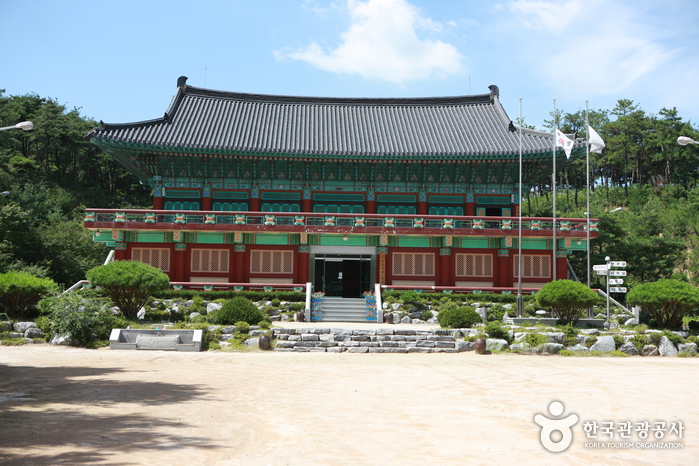
Chunguisa (the memorial site of patriot Yun Bong-gil) sits near Deoksan Hot Springs in Yesan, preserving the ground where Yun Bong-gil was born and lived before leaving for China. The site gathers his story into one walk, from Gwanghyeondang, his birthplace, and Jeohandang to Buheungwon, along with a memorial stone, statue, shrine, and the Yun Bong-gil Memorial Hall displaying his belongings.
The grounds feel calm and deliberate, with open-air paths that carry both rural quiet and the weight of modern Korean history. It is a place where reverence settles in slowly, between old houses, trees, and monuments built to hold memory in place.
Start with the preserved houses to trace Yun Bong-gil's early life, then continue to the shrine, statue, and memorial hall for the fuller historical arc. The annual memorial ceremony is held on Apr 29, the date of his historic action in Shanghai, and Korean-language guided service is available by advance reservation.
Wind skimmed the water in silver ripples, and the shoreline seemed to stretch forever. Yedang Reservoir, also called Yedangho, is vast enough to change your sense of scale. Built in 1964 to supply agricultural water, it now feels like a place where utility gave way to beauty without losing its original dignity. I walked slowly, letting the lake open in front of me while families drifted toward cafes, footpaths, and the waterside spaces scattered around the reservoir.
What stayed with me most was dusk. As the sun dropped, the famous golden tree by the reservoir caught the last of the light and seemed to burn from within. The bridges, sculpture park, and walking routes gave the area shape, but it was the glow on the water that held everyone still for a moment. No ticket gate, no ceremony, just that sudden shared pause when a landscape turns theatrical. It was the kind of evening that makes you understand why a reservoir can become a destination.
The air changed at Chunguisa, the memorial site dedicated to Yun Bong-gil, a Korean independence activist whose act of resistance in Shanghai in 1932 became one of the defining moments of the anti-colonial struggle. The grounds are quiet, almost restrained, and that restraint gives the place its force. Instead of overwhelming you, it draws you inward.
Here, near Deoksan Hot Springs, Yun Bong-gil was born and lived before leaving for China. Standing before Gwanghyeondang, his birthplace, and Jeohan-dang, the house where he lived before his departure, I felt history narrow from textbook scale to human scale. A room. A courtyard. A threshold crossed once, and then never uncrossed. The most memorable moment of the day came not from a dramatic exhibit, but from that realization: courage often begins in ordinary places, in homes that still hold the shape of a life before it changed the world.
By the time I reached Deoksan Hot Springs District, my shoulders had dropped and my pace had slowed to match the town. The hot spring area has been known for centuries, wrapped in local lore and old records that praise the healing quality of its water. One story tells of an injured crane that returned to strength after touching the spring water, a legend that makes sense when you arrive and feel how naturally healing belongs to this landscape.
Deoksan Hot Springs has been developed as a bathing destination since 1917, and the area still carries that enduring promise of relief. I liked the contrast: earlier in the day I had walked through a place of conviction and sacrifice; here, I ended among warmth and mineral-rich calm. It did not feel like a change of subject. It felt like the same region revealing another side of care, another way the land sustains the people who come to it.
Deoksan Oncheon Jigu (Deoksan Hot Springs District) is one of Chungcheongnam-do’s best-known hot spring areas, long celebrated for its mineral-rich waters and selected as one of Yesan’s ten scenic highlights. Developed in earnest in 1917 but rooted in much older local lore, the district brings together hot spring baths, hotels, restaurants, and easy visitor amenities in one outdoor resort zone.
Steam, hotel facades, and the slow rhythm of a spa town give the area a relaxed, restorative mood. It feels less like a single landmark and more like a place where travelers come to soak, linger, and let the day loosen its grip.
Walk the district with the old crane legend in mind, then choose from the on-site bathhouses, hotels, and dining spots for a deeper stop rather than a quick photo visit. The area is open year-round, and practical facilities such as restrooms and multiple lodging options make it easy to visit with family or fold into a longer stay.
Yesan stayed with me as a place where gentleness and resolve live side by side. I left feeling that its truest beauty lies not only in what you see, but in how quietly it teaches you to slow down and look again.
Travel tips
Walk this story
Places in this story
3 places
Itinerary
1 day
Region
충남
Places you can import
3 places

Comments
See what other travelers are saying.
Sign in to leave a comment
You can sign in with Google, Kakao or Naver.