TRAVELER STORY · 경북
Written by AI from Korea Tourism Organization travel-course data. It is not a real visitor’s review, so check hours and travel times before you go.
A slow day of sea wind, old pavilions, bright sand, and the kind of calm that lingers long after sunset.
On this stretch of Korea's East Sea coast, the wind smells of pine and salt, and even a simple walk begins to feel ceremonial.
The first thing I noticed at Giseong Mangyang Beach was the sound. Wind moved through the haesong, Korean coastal pines, with a dry whisper, while the surf rolled in with a steadier, deeper rhythm. The beach opened wide in front of me, a long sweep of pale sand and startlingly clear water, the kind of coastline that makes you slow your pace without meaning to.
I had come to Uljin for exactly this feeling: space, light, and the ease of being somewhere that has not been polished into spectacle. At Giseong Mangyang Beach, that ease felt immediate. Families drifted across the sand, the pine grove cast long ribbons of shade, and the whole shore seemed to breathe at its own unhurried tempo.
Giseong Mangyang Beach is a broad East Coast shore where tall haesong pine trees rise behind a wide strip of pale sand. Travelers come for the notably clear water, the open beachscape, and the old site of Mangyangjeong Pavilion, once counted among the famed Gwandong Eight Scenic Views. In summer, the nearby roadside turns into a memorable 'squid street' lined with drying squid in the sea breeze.
The beach feels spacious and unhurried, with resin-scented pine groves and a long sweep of sand meeting the bright East Sea. It is the kind of place that invites a slow walk, a deep breath, and a lingering look at the horizon.
Walk from the sandy shore into the pine grove for a change of mood, then look toward the village front for the old Mangyangjeong Pavilion site and its historic coastal view. Admission is free, and during the summer squid season, do not miss the striking roadside scene of squid drying on both sides of the road.
Salt sat on my lips as I walked north along the waterline, shoes in hand, letting the cold edge of the sea chase my ankles. The beach is generous in every sense, wide enough to make even a busy summer day feel expansive, clean enough that the water catches the sky like glass. It is the kind of place that invites aimless movement, and that is exactly how it should be experienced.
Behind the sand, the thick pine grove gave the coast another layer of character. I kept slipping back into the trees for a few cool minutes before returning to the glare and shimmer of the shore. That contrast stayed with me: resin and salt, shade and sun, stillness and surf. It felt like the landscape was constantly changing its mood while never losing its calm.
In summer, locals say the roadside can turn into a striking "squid street," where squid hang drying in rows in the sea breeze. Even without seeing it, I could imagine the scene: practical, vivid, deeply coastal. Uljin does not separate daily life from beauty; it lets them exist side by side.
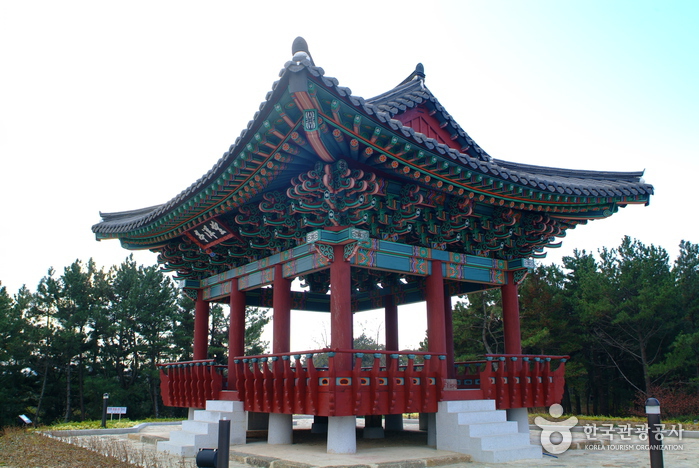
At Mangyangjeong, the air shifted again. Up on the pavilion grounds, the sea no longer felt close and physical; it became vast. The horizon stretched outward in a clean blue line, and below it the coast unfolded with a quiet grandeur that explained why Mangyangjeong has long been counted among the Gwandong Palgyeong, the Eight Scenic Views of Korea's eastern region.
What moved me most was not only the view, but the weight of time behind it. Mangyangjeong has been rebuilt and relocated across centuries, surviving storms, repairs, and changing eras before settling in its present position. Standing there, I felt that layered history without needing a plaque to explain it. The pavilion seemed to do what the best historic places do: hold memory lightly, and let the landscape speak first.
I stayed longer than I expected. The Wangpicheon stream area and the open East Sea beyond created a scene that felt both composed and wild, as if painters, scholars, and ordinary travelers had all once stood in the same wind and understood the same thing. Some views are famous because they are photographed well. This one is famous because it slows the mind.
Mangyangjeong, a historic pavilion of the Gwandong Palgyeong (the Eight Scenic Views of Korea's eastern region), stands on a hill above the East Sea with a sweeping outlook over the Wangpicheon stream and the coast. Its site has shifted over centuries, but its reputation has held fast: kings praised the view here, and generations of writers turned the scene into literature.
The place feels wind-shaped and wide open, with the sea spreading out in one direction and the river valley softening the horizon in another. It is the kind of lookout that invites you to slow your pace and let the landscape do the talking.
Walk the hilltop slowly and take in the layered view of the East Sea, Wangpicheon, and the shoreline in a single frame. The official nearby travel courses include Mangyangjeong Beach, Seongnyugul Cave, and the Buryeongsa Valley route, making this an easy scenic stop within a longer Uljin coastal drive.
백암온천 관광특구는 백두대간의 산자락과 동해안 여행길이 맞닿는 울진의 온천 지대입니다. 신라 때부터 알려진 온천이라는 이야기가 전해지며, 무색무취한 온천수 덕분에 오래 머물며 몸을 풀기 좋은 곳으로 기억됩니다.
해변의 바람을 맞고 들어온 뒤 온천로를 따라 걸으면, 산 아래 온기가 묵직하게 깔린 듯한 분위기가 느껴집니다. 화려한 관광지라기보다 오래된 온천 마을의 생활감이 남아 있는 편입니다.
시설마다 이용 방식이 다르므로 온천욕을 계획한다면 먼저 원하는 시설을 정해 확인하는 동선이 좋습니다. 주차장과 화장실이 있으며, 울진군 홈페이지에는 영어, 중국어, 일본어 안내가 지원되고 관광 안내소에는 영어, 중국어 등의 외국어 안내 책자가 비치되어 있습니다.
By late afternoon, the sun had softened and the beach had taken on a muted gold. I found myself back near the shore, watching the line where the pines ended and the sand began. Nothing dramatic happened, and that was the point. Uljin offered no rush, no hard sell, no need to perform wonder. It simply gave me enough beauty to settle into.
On the drive away, I thought about the hot springs farther inland, the sulfur-rich baths that many travelers pair with this coast. That combination suddenly made perfect sense. After a day of sea wind and long walking, the idea of slipping into mineral water felt less like an itinerary item and more like the natural final note.
What remained with me was a rare kind of spaciousness. Not emptiness, but room: room to look, to breathe, to hear myself think. On this part of the East Coast, leisure is not an indulgence. It is the landscape's most convincing invitation.
Uljin stayed with me as a place of elemental balance: pine and surf, history and stillness, movement and rest. Long after I left, I could still hear the wind in the trees and feel the cool edge of the sea at my feet.
Travel tips
Walk this story
Places in this story
3 places
Itinerary
1 day
Region
경북
Places you can import
3 places

Comments
See what other travelers are saying.
Sign in to leave a comment
You can sign in with Google, Kakao or Naver.