TRAVELER STORY · 서울
Written by AI from Korea Tourism Organization travel-course data. It is not a real visitor’s review, so check hours and travel times before you go.
From a high pass in Odaesan to a quiet beach and a hard-working fishing port, this is Gangneung at its most elemental.
In Gangneung, the road does not choose between mountain and sea; it lets you have both, with a river of stone and pine threading them together.
Cold air met me first. It came clean off the heights around Jingogae Pass, sharp with pine and wet earth, the kind of mountain breath that makes you stand still for a second before moving on. I came to Gangneung because it promised a rare kind of day: mountains behind me, the East Sea ahead, and a valley in between that would slow the whole journey into something worth remembering.
Gangneung wears its geography boldly. The spine of the Baekdudaegan mountain range runs through this part of Korea like a wall, steep and ancient, carving out deep folds of land before releasing them toward the coast. Starting high above the shoreline, I had the feeling that the day was already flowing downhill with me, from ridge to stream, from stream to sea.
Jingogae is a long-running Korean restaurant in the Euljiro-Chungmuro area, serving diners since 1963. It is best known for eobok-jaengban, a rare beef hot pot piled high with thick slices of meat, mushrooms, vegetables, mandu dumplings, rice cakes, and egg, simmered with soy sauce at the center for a deep, clean broth.
The place carries the steady confidence of an old Seoul institution: polished side dishes, bubbling pots, and the comforting noise of a meal meant to be shared. Even before the first bite, the table feels generous and full of history.
Come hungry and order a hot pot if you want the signature experience, especially the eobok-jaengban or gopchang-jeongol, a seasoned beef tripe stew. The menu is broad, the side dishes are notably neat and refreshing, and the restaurant works well for travelers with children.
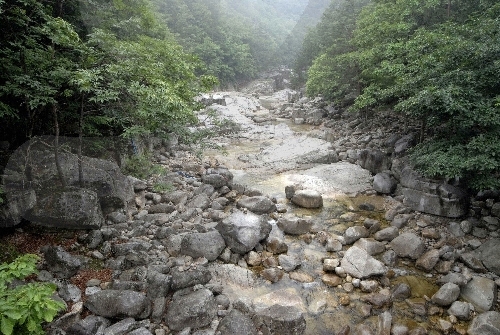
The valley announced itself with sound before sight: water striking rock, a steady silver noise beneath the trees. Odaesan Sogeumgang Valley, in the eastern district of Odaesan National Park, feels less like a single viewpoint and more like a slow unfolding. Forest closes in, then opens. Pale cliffs rise through the leaves. Pools catch the light like polished glass.
Locals compare these crags to a smaller Geumgangsan, one of the Korean Peninsula's most celebrated mountain landscapes, and the name Sogeumgang, "Little Geumgang," suddenly makes sense when you are inside it. I walked beside the stream as if being drawn forward by it, passing stretches where the rocks looked sculpted rather than eroded, and deeper pockets of shade where the air turned cool enough to raise goosebumps on my arms.
What stayed with me most was the rhythm of the place. Not one dramatic reveal, but a chain of them: cliffs, clear water, dense woods, another bend, another cascade. It felt immersive in the truest sense, as though the valley was not trying to impress me from a distance but pull me into its scale.
Odaesan Sogeumgang Valley unfolds through the eastern reaches of Odaesan National Park, where sharp rock faces and dense forest create a landscape often compared to a miniature Geumgangsan, the famed Diamond Mountains. Along the valley, the stream winds past dramatic sights such as Mureung Valley, Guryong Falls, Gunja Falls, and Manmulsang, giving the route the feel of a long, unfolding mountain story.
The valley feels cool, deep, and quietly theatrical, with cliffs rising above clear water and thick woods closing in around the trail. Every bend pulls the eye forward, as if the mountains are revealing themselves one stone wall and waterfall at a time.
Follow the valley route slowly to appreciate how the scenery shifts from streamside rock formations to named viewpoints and waterfalls across the long gorge. Parking and toilets are available, which makes this an approachable stop for a longer nature outing in Gangneung.
The smell changed before the view did. Mountain damp gave way to salt, and then, around Yeongjin Beach, to the faint roasted sweetness of coffee drifting through the coastal air. This part of Gangneung is famous for its cafe culture, but Yeongjin itself still feels like a small fishing village first, with a modest harbor, tidy sand, and the practical calm of a place that works for a living.
I reached the beach in a softer hour of the day, when the water looked brushed with steel-blue light and the shore seemed almost private. Families come here in summer, and it is easy to see why: the beach is gentle, clean, and unshowy. But what I loved was the in-between feeling of it, where village life and seaside ease overlap. Fishing boats sat nearby as if ready to interrupt the scenery at any moment.
There is also the quiet thrill of knowing that traditions still pulse beneath the postcard surface. Every few years, the village holds a ritual for a plentiful catch, a reminder that on this coast the sea is not only admired, it is depended on. That gave the beach a different depth for me. It was beautiful, yes, but never decorative.
Yeongjin Beach is a quiet stretch of coast in Gangneung, where a small fishing village meets a clean, open shoreline. Set beside Yeongjin Port, it offers gentle seaside views, working boats, and the familiar breakwater made famous by the drama Goblin.
The mood here is calm and salt-heavy, with the smell of the sea drifting in from the harbor. It feels less like a polished resort beach and more like a lived-in coastal village with an honest, everyday rhythm.
Walk first to the breakwater for the best-known drama photo spot, then linger by the harbor to watch the fishing village at work. Entry is free, parking and toilets are available, and travelers with pets can visit together.
Jumunjin Port hit me in waves of noise and brightness: gulls wheeling overhead, engines grumbling, the flash of fish laid out under market lights. After the hush of the valley and the calm of Yeongjin, the port felt gloriously alive. This is one of the East Coast's major fishing hubs, where warm and cold currents meet and fill the waters with squid, herring, anchovy, pollock, and more.
I watched boats come and go and understood quickly that Jumunjin is not staged for visitors, even if visitors are everywhere. The market grew around the harbor decades ago and still moves with that old commercial energy. Dried seafood, fresh catch, knife work, shouted prices, plastic tubs, salt on the breeze, all of it layered into one dense and memorable scene. If Yeongjin was a whisper, Jumunjin was a full voice.
My favorite moment came at the end, standing near the water with the smell of the sea on my jacket and the market still buzzing behind me. The whole route suddenly made sense: the mountains had not ended at the coast, they had simply changed form, becoming river, then beach, then harbor. In Gangneung, the landscape does not break into separate attractions. It travels with you.
Jumunjin Port is one of the East Coast's busiest fishing harbors, where cargo vessels and roughly 350 fishing boats move in and out against a backdrop of salt wind and working docks. Cold and warm currents meet here, so the catch is famously varied, from squid and pollock to herring and anchovies. The harbor also connects naturally to Jumunjin Market, a long-established traditional market with seafood stalls, dried fish shops, and raw fish centers.
The place feels brisk, noisy, and vividly alive, with gulls overhead and the sharp scent of the sea rising from the piers. It is less a polished waterfront than a working harbor, and that honesty is exactly what makes it memorable.
Walk the harbor first to watch the boats and the day’s catch, then continue into Jumunjin Market for the full rhythm of the port. Entry is free, the site is pet-friendly, and the freshest raw fish is the real highlight here.
What lingered was not a single view but the transition between them: pine air, cold stream, coffee-salted shore, and the raw pulse of the port. Gangneung felt like a place in motion, carrying mountain strength all the way to the sea.
Travel tips
Walk this story
Places in this story
4 places
Itinerary
1 day
Region
서울
Places you can import
4 places

Comments
See what other travelers are saying.
Sign in to leave a comment
You can sign in with Google, Kakao or Naver.