TRAVELER STORY · 충북
Written by AI from Korea Tourism Organization travel-course data. It is not a real visitor’s review, so check hours and travel times before you go.
A slow wander beside the stream leads through three traditional markets and into the ringing heart of an old blacksmith's forge.
In Chungju, the markets do not simply sell things; they reveal a city through steam, hammer blows, and the small rituals of everyday trade.
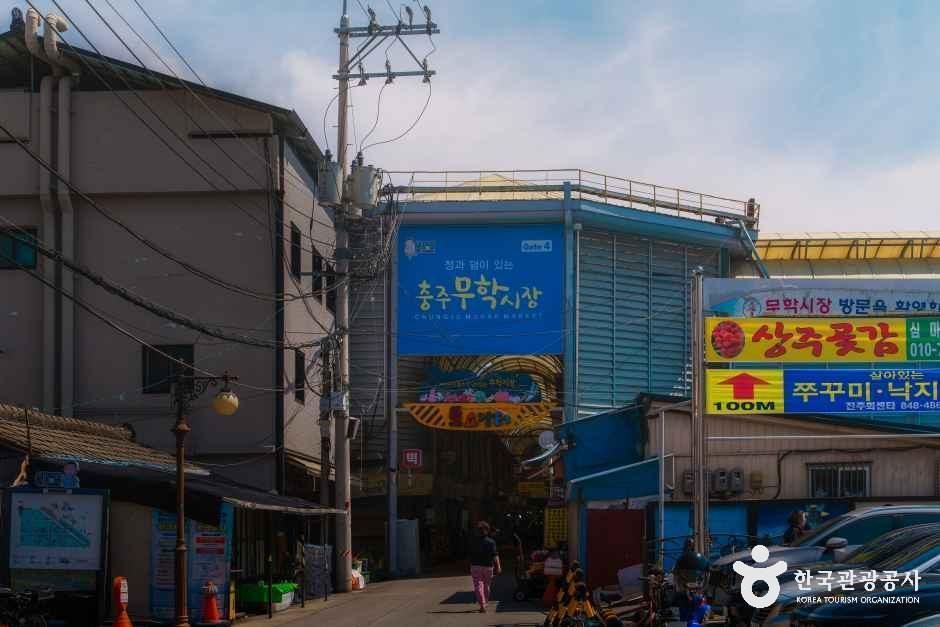
The first thing I noticed was the sound: shutters rattling open, vendors calling across the lane, and the low rush of the stream cutting through central Chungju. I had come looking for a market walk, but what I found along the banks of Chungjucheon was something more intimate. Muhak Market, Chungju Jayu Market, and Chungju Public Market stand shoulder to shoulder here, close enough that one spills naturally into the next.
That closeness changes the rhythm of the day. I drifted from racks of clothes to crates of vegetables, from gleaming fish laid over ice to fruit stacked in careful pyramids, never really sure where one market ended and the next began. It felt less like sightseeing and more like entering the daily bloodstream of the city, where errands, gossip, lunch, and memory all share the same narrow streets.
Muhak Market is a long-running traditional market in central Chungju, shaped by the city’s street vendors in 1978 and still rooted in everyday trade. Beneath its practical rooflines, you can browse clothing, vegetables, fish, fruit, and simple market snacks while watching local life unfold at a steady, unpolished pace.
The market feels lived-in rather than staged, with the sound of vendors, the smell of fresh produce and seafood, and the constant rhythm of neighbors stopping to talk. Walk slowly and the place reveals its real charm: commerce, routine, and memory sharing the same narrow lanes.
Pair it with nearby traditional markets along the Chungjucheon Stream for a fuller walk through the city’s market culture, and keep an eye out for Samhwa Blacksmith Shop, one of the few remaining blacksmith workshops of its kind. Barrier-free features are a real advantage here, with accessible parking, accessible restrooms, and public transport connections.
Chungju Jayu Market, a traditional open-air market in central Chungju, stands on the old north gate site of Chungju Eupseong, the former town fortress. What began as a five-day market grew into a permanent market, and its lanes still carry the texture of local trade, from clothing and bedding fabrics to the everyday rhythm of a working city.
The market feels lived-in rather than polished, with roadside storefronts giving way to narrower inner alleys where the older character lingers. Come in the evening, and the mood shifts as the Chungju Nuri Night Market fills the air with street food, traditional performances, and busking.
Walk it as part of the larger market belt along Chungjucheon Stream, where Muhak Market, Jayu Market, and Gongseol Market sit shoulder to shoulder. Stay for the Chungju Nuri Night Market if it is operating, especially if you want food stalls and live performances rather than daytime shopping alone.
Chungju Gongseol Market is a long-running traditional market in central Chungju, opened on December 30, 1964, as part of a government market initiative for small merchants. Linked with Muhak Market and Jayu Market, it unfolds into a dense everyday landscape of chicken, sundae, bunsik, vegetables, fish, and the market meals that keep locals coming back. Set beside the streams flowing toward the Namhangang River, it is especially known for its food stalls and the sundae-gukbap district between Gongseol Market and Muhak Market.
This is a market of movement, voices, steam, and practical appetites. The lanes feel lived-in rather than polished, and that honesty is exactly what gives the place its warmth.
Walk the connected stretch of Gongseol Market, Muhak Market, and Jayu Market instead of treating them as separate stops; the pleasure here comes from following the flow of daily life from one arcade to the next. Look out for the well-known sundae-gukbap area and the market corners where old trades still survive, and note that the site supports barrier-free travel with accessible parking, routes, entrances, and public transportation links.
The air in Muhak Market smelled of greens just misted with water, ripe peaches, and the faint salt of seafood. This is not a market staged for visitors. It has the practical, lived-in energy of a place built by necessity, a place that grew when street vendors were given room to survive and turn trade into permanence.
I liked the unpolished honesty of it. Shoppers moved with purpose, comparing produce, checking prices, pausing at food stalls for a quick bite. Between the more functional rows, there were moments of softness: a vendor straightening a display by hand, an older customer lingering to talk, the casual generosity that markets often carry. For an international traveler, that is the real gift here. You do not just see what Chungju sells; you see how it lives.
By the time I reached Chungju Jayu Market, the atmosphere had shifted. The roadside shops flashed with clothing and jewelry, while deeper inside the alleys the mood turned older, denser, almost archival. This market stands where the old north gate of Chungju's fortress town once stood, and that history still seems to cling to the corners. Even without walls or gates, the place feels like an entrance point, a threshold between past commerce and present-day bustle.
From there I moved into Chungju Public Market, and the scent changed again, this time to broth, fried batter, and the savory pull of comfort food. Stalls selling chicken, vegetables, fish, street snacks, and sundae-gukbap, a hearty blood-sausage soup with rice, gave the market its warmth. The most memorable moment of the whole walk may have been standing still with a bowl nearby and steam rising into the afternoon, watching locals eat quickly, talk loudly, and carry on as if the market had always been waiting for them.
Then came the sharp metallic strike of hammer on iron, and everything else fell away. Near Muhak Market, inside the Chungju Nuri Center, Samhwa Blacksmith is still at work, one of the few places of its kind left in the country. The forge does not look romantic in the old-fashioned way. It sits in a modern building. But the craft itself is undiminished, and that is what matters.
Watching the blacksmith heat, quench, and shape metal was the part of the day that stayed with me longest. Tools hung by the window caught the light: hoes, sickles, knives in different sizes, each made for use rather than display. There was something deeply moving about that continuity. For more than sixty years, this has been a place where fire and labor become objects that fit into someone's hand. After hours of wandering through goods meant to be bought and carried away, the forge offered a quieter thought: some trades do more than survive; they hold a community's memory in steel.
Samhwa Daejanggan (a traditional blacksmith workshop) sits on the first floor of Chungju Nuri Center beside Muhak Market in central Chungju. Opened in 1964 under the name Samhwa Cheolgongso, it is run by a master smith who has spent more than six decades heating, quenching, and shaping iron into everyday tools. Travelers can watch the forge at work, then move into the display-and-sales area lined with hoes, sickles, knives, pulleys, and iron door hardware.
The old-world romance of a rural forge is softened by the modern building, but the sound of hammer on metal still gives the place its pulse. It feels practical, warm, and deeply human, especially with the market streets flowing around it.
Watch the quenching process at the custom-made furnace, then slow down at the window display where farm tools and household ironwork reveal the craft in detail. If available, join the hammering experience with the master smith and receive a homi, a hand hoe, as a souvenir, then continue into the connected lanes of Muhak Market, Jayu Market, and Gongsul Market.
I left Chungju feeling that I had walked through more than three markets. I had stepped into a city that still lets you hear its old rhythms, from simmering soup pots to the clean, bright ring of iron being shaped by hand.
Travel tips
Walk this story
Places in this story
4 places
Itinerary
1 day
Region
충북
Places you can import
4 places

Comments
See what other travelers are saying.
Sign in to leave a comment
You can sign in with Google, Kakao or Naver.