TRAVELER STORY · 인천
Written by AI from Korea Tourism Organization travel-course data. It is not a real visitor’s review, so check hours and travel times before you go.
A walk through Incheon reveals a port city where fairy-tale colors, smoky fish grills, and the memory of opening to the world still live side by side.
In Incheon, history does not sit behind glass for long; it spills into alleyways, grill smoke, painted walls, and the easy rhythm of an ordinary day.
Color hit me first. At Songwol-dong Fairy Tale Village, murals climbed over walls and stairways in bright, unabashed bursts, turning an old hillside neighborhood into something between a storybook set and a lived-in community. I had come looking for hidden corners of Incheon, a city so close and familiar to many Koreans that it can be easy to overlook. But this was exactly the kind of place that rewards slowing down.
What makes the village memorable is not just the painted scenes. It is the contrast underneath them. Songwol-dong was once a prosperous residential area after Incheon Port opened in 1883 and foreign residents settled nearby, then later lost its energy as younger generations moved away. The fairy-tale makeover did more than decorate the streets; it gave the neighborhood a second life. As I walked uphill past tidy lanes and cartoon-bright facades, I could still feel the older village beneath the paint, which made the charm feel earned rather than manufactured.
Songwol-dong Fairytale Village is an outdoor mural village in Jung-gu, Incheon, where aging residential lanes were transformed with scenes from famous fairy tales. What was once a fading hillside neighborhood now draws travelers with painted walls, playful sculptures, and a layer of local history beneath the color.
The village feels bright, whimsical, and slightly nostalgic at once. As you climb through the lanes, the cheerful artwork softens the old textures of the neighborhood and gives the whole walk an easy, familiar warmth.
Walk slowly through the alley network rather than rushing to a single photo stop; the charm here comes from turning corners and finding new storybook scenes on walls and stairways. This is an outdoor spot that is open at all times, and travelers with pets can explore the village together.
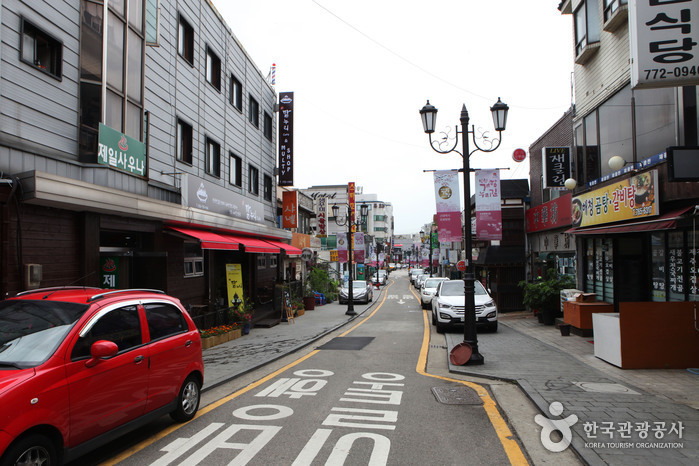
Dongincheon Samchi Street is a food alley in Jung-gu, Incheon, known for its long row of casual restaurants and its signature dish, samchi-gui, grilled Spanish mackerel. Designated as a specialty food street in 2002 and selected for Incheon’s 100 tourist picks, it grew from the popularity of one local restaurant into a full lane of fish-grill spots. Today, it remains one of those easygoing places where local food culture feels close, lively, and unmistakably real.
The street feels friendly and unpolished in the best way, with the smell of grilled fish hanging in the air and diners settling in over simple, satisfying plates. It carries the mood of everyday Incheon: modest, busy, and full of appetite.
Walk the full stretch beside the student education and culture hall, then choose a restaurant for samchi-gui and, if you like, a glass of makgeolli, Korean rice wine. Parking is available, and the alley works best as a relaxed meal stop within a broader old-town walk through Dongincheon.
Gaehangjang Street (Incheon's old Open Port district) preserves the mood of the late 19th century, when foreign trade reshaped the city and modern architecture first arrived on these blocks. As you walk, you pass former settlement boundaries, Western-style buildings, and cultural landmarks that stitch together Incheon's port history with its present-day street life. It is one of the clearest places in the city to feel how 130 years of history still survive at sidewalk level.
The street feels layered rather than polished: brick walls, old facades, and museum doors carry the salt-air memory of the port. It is a place where everyday footsteps move through a district that still quietly holds the drama of Incheon's opening to the world.
Walk slowly and link the street with nearby heritage stops such as Incheon Open Port Museum, Incheon Art Platform, Chinatown, and the Jjajangmyeon Museum in the former Gonghwachun building. Entry to the street is free, pets are allowed, and you can reserve a free walking commentary service; foreign-language guiding is also available in English, Chinese, and Japanese.
The air changed before I even saw the signs. In Dongincheon Samchi Street, the smell of grilled fish drifted down the lane in warm, oily waves, and suddenly the day became about appetite. Samchi-gui, grilled Spanish mackerel, is the dish that built this street's reputation, its skin blistered over fire and its flesh rich, soft, and deeply savory.
This is not a polished dining district designed for spectacle. That is precisely why it works. The street grew organically after one restaurant became known for its mackerel, and others followed, until an entire lane was shaped by one humble, irresistible craving. I sat down where the smoke was thickest, ordered the fish, and understood immediately why locals pair it with makgeolli, a lightly sparkling Korean rice wine. The meal felt deeply Incheon: generous, unfussy, and rooted in working-day pleasure rather than ceremony.
Stone steps, old facades, and the hush of side streets drew me into Gaehangjang Street, the Open Port district where late-19th-century Incheon still lingers. Here the city tells the story of how Korea met the modern world through trade, diplomacy, and foreign settlement. Walking the area, I passed traces of former concession zones and Western-style buildings that once signaled a new age arriving by sea.
What struck me most was how naturally history sits in the neighborhood. It is not sealed off from daily life. You move from heritage architecture to contemporary cafes, from old warehouses reborn as cultural spaces to streets that still carry the layered memory of Chinese, Japanese, and other foreign communities who once shaped this port. For an international traveler unfamiliar with Korea's opening-era history, this district makes the story tangible. You do not need a lecture. The streets do the explaining.
Cool stone and a sudden quiet settled around me as I stepped into the Incheon Open Port Museum, a former bank building with a dignified dome and late Renaissance styling. After the bustle outside, the museum felt like entering the city's memory vault. The building itself matters as much as the exhibitions: a preserved piece of early modern architecture that reflects the ambitions and upheavals of the port era.
Inside, the galleries trace the goods, technologies, and ideas that entered Korea through Incheon after the port opened. That context sharpened everything I had seen earlier in the day. The bright village, the fish street, the layered streetscape of the old port all suddenly belonged to the same story. By the time I stepped back outside, Incheon no longer felt like a quick stop near Seoul. It felt like a city that had quietly taught me how modern Korea began to take shape.
Incheon Gaehang Museum, a museum of Incheon's opening-port history, stands inside the former First Bank of Japan branch, a late Renaissance stone building crowned with a central dome. Its four permanent exhibition halls trace the modern goods and ideas that first entered Korea through Incheon Port after the port opened.
The place feels stately yet approachable, with cool stone, old banking grandeur, and the quiet weight of a city meeting the modern world for the first time. History here is not distant; it lingers in the building itself.
Start on the first floor, where the information desk leads directly into Exhibition Rooms 1 through 4, and follow the displays in order to understand how Incheon changed after the port opened. Pay attention to the architecture as much as the artifacts: the domed hall and stone facade are part of the experience.
What stayed with me was Incheon's honesty. Beneath the murals, grill smoke, and old stone buildings, the city felt warm, resilient, and entirely itself.
Travel tips
Walk this story
Places in this story
4 places
Itinerary
1 day
Region
인천
Places you can import
4 places

Comments
See what other travelers are saying.
Sign in to leave a comment
You can sign in with Google, Kakao or Naver.