TRAVELER STORY · 강원
Written by AI from Korea Tourism Organization travel-course data. It is not a real visitor’s review, so check hours and travel times before you go.
A winter journey through clean mountain air, resilient food traditions, and starlit silence on the edge of the DMZ.
In Yanggu's high bowl of land near the border, even a humble dried radish leaf tastes like mountain air, hard winters, and the patient warmth of a farming village.
The first thing I noticed in Yanggu was the air. It had that sharp, high-country clarity that makes every breath feel scrubbed clean, and it carried the faint earthy scent of fields put to rest for winter. I had come for siraegi, dried radish greens, a Korean staple that turns humble leaves into something deeply savory and nourishing, and this remote basin called Punchbowl seemed like exactly the right place to understand why people speak of it with such affection.
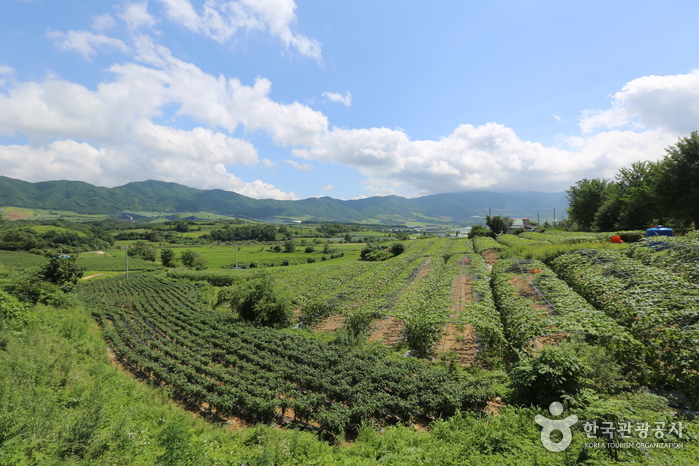
Haebang-myeon, in the Punchbowl basin near the DMZ, feels both exposed and sheltered at once. The land sits high, ringed by ridges, with big swings between day and night temperatures and the kind of pristine natural environment that farmers trust. That climate, I was told again and again, is what gives Punchbowl siraegi its special quality. You taste it not as luxury, but as depth: a clean, rustic richness that feels earned by wind, frost, and time.
DMZ Punchbowl Dulle-gil is a 73.2 km forest trail network spread across a high basin in Haean-myeon, Yanggu, a landscape shaped by war and now reclaimed by quiet woods and long views. The route unfolds through four themed courses tied to peace, history, and mountain culture, with nearby security-tourism stops such as the Fourth Tunnel, Eulji Observatory, Yanggu Unification Hall, and war memorial sites.
The walk carries a rare tension between stillness and memory: bird calls in the trees, open sky over the basin, and the lingering weight of the borderland. It feels both serene and watchful, as if nature has softened the edges of history without erasing them.
You cannot explore independently here, so the guided walk itself becomes part of the experience; follow the forest trail interpreter and pay attention to how each course frames the Punchbowl basin differently. If you visit in December, pair the trail with the nearby DMZ Punchbowl Siraegi Festival, where dried radish greens and local farm produce take over the Haean Rest Area Plaza.
At the Center of the Korean Peninsula Observatory, known as Gukto Jeongjungang Observatory, travelers look up from near the geographic heart of the peninsula and step into a place built for both skywatching and learning. Opened in 2007 in Yanggu, it combines an observatory deck, exhibition halls, a planetarium, and commentary programs that make constellations and planets feel close enough to follow by eye.
The mood shifts from bright mountain air to quiet anticipation as evening approaches and the sky deepens overhead. It feels both educational and cinematic, with open lawns, sweeping views, and the hush that comes before the first stars appear.
Start with the exhibition hall or planetarium, then move to the observatory deck as the light fades for the most memorable sky-viewing moment. The site also includes a video hall, souvenir shop, snack bar, lawn plaza, restrooms, and parking, making it an easy stop to pair with a day exploring the Punchbowl highlands and the DMZ Punchbowl siregi, dried radish greens, festival in December.
Some places announce themselves with monuments. Yanggu does it with steam and smell. I imagined December here during the DMZ Punchbowl Siraegi Festival, when the square around the Haean Rest Area fills with visitors, local produce, and specialties made from siraegi and Yanggu crops. It is easy to see why people come. This is not food polished for display. It is food that tells you exactly where you are.
What stayed with me most was the idea of riding a tractor-pulled wagon past rows of drying greens, watching winter light fall across the racks. There is something wonderfully direct about it. No performance, no gloss. Just a community showing how its land feeds it. For travelers unfamiliar with Korean countryside food culture, this is the point where the story clicks: siraegi is not simply an ingredient, but a way of preserving the season, stretching the harvest, and turning restraint into comfort.
Boots on frozen earth, pine in the air, distant hills folding into one another: the DMZ Punchbowl Trail was where the landscape stopped being an idea and became a feeling. The basin stretches across a highland area in Haean-myeon, and from the trail the terrain makes immediate sense. A war correspondent once looked at this hollowed landscape during the Korean War and called it Punchbowl because of its shape. The name stayed. So did the tension between beauty and history.
The trail network, 73.2 km in total, is built around themes of war, peace, forest culture, and memory. Walking here, I never felt like I was moving through scenery alone. The nearness of the civilian control zone, the presence of sites tied to the armistice line, and the quiet breadth of the forest all gave the route unusual weight. It is one of those rare walks where your body relaxes even as your mind sharpens.
The practical rhythm matters here. Exploration departures are at 09:20 and 13:20, and visits are possible only with reservations for groups of two or more. Go with enough time to slow down. This is not a trail to rush for a photo and leave. Let the silence do some of the talking.
By evening, the cold had deepened enough to sting my cheeks, and the sky above Yanggu felt impossibly wide. At the Center of Korea Observatory, a stargazing observatory near the geographical heart of the Korean Peninsula, the experience shifted from earthbound to celestial. The building itself is purposeful rather than theatrical, but the real drama begins when the lights dim and someone starts pointing out constellations and planets above the mountains.
Opened in 2007, the observatory was created so visitors could look up from the middle of the country and understand the sky with fresh attention. Inside, the exhibition spaces and digital planetarium make the cosmos feel accessible; outside, the night restores a sense of scale. I left with that rare travel feeling that the day had widened rather than ended, beginning with dried greens in a winter basin and closing under stars older than any border.
Summer hours are [Apr–Sep] 14:00–23:00, and winter hours are [Oct–Mar] 14:00–22:00. Stay long enough for the sky to fully darken. The stars are the final course.
Yanggu lingered with me as a place of quiet strength: a landscape shaped by altitude, history, and winter, yet made generous through food and human warmth. Long after I left, I could still taste the deep, rustic comfort of siraegi and see the cold stars hanging above the Punchbowl.
Travel tips
Walk this story
Places in this story
2 places
Itinerary
1 day
Region
강원
Places you can import
2 places

Comments
See what other travelers are saying.
Sign in to leave a comment
You can sign in with Google, Kakao or Naver.