TRAVELER STORY · 경북
Written by AI from Korea Tourism Organization travel-course data. It is not a real visitor’s review, so check hours and travel times before you go.
A restorative journey through Unje-san, Jukdo Market, Bogyeongsa, and the cool hush of mountain waterfalls.
Pohang felt less like a seaside city than a conversation between stone, salt, temple bells, and falling water.
The first thing I felt on Unje-san was the grip of the rock under my shoes. The mountain rose only 478 meters, but its craggy cliffs had the presence of something older and sterner, as if the land had been folded upward by hand.
I had come to Pohang expecting the sea. Everyone does. But here, above the valleys, the city’s coastal brightness gave way to pine shade, stone faces, and stories of Buddhist masters. Local tradition says the mountain’s name may come from cloud bridges once used between hermitages perched across a gorge; another story links it to Lady Unje, queen of the Silla kingdom. Either way, the name suits the place. Clouds seem to belong here.
Walking slowly, I understood why monks such as Wonhyo, Jajang, and Hyegong were said to have practiced on this mountain. The silence did not feel empty. It had weight.
Unjesan Mountain rises 478 meters above southern Pohang, offering a rugged counterpoint to the city’s better-known sea views. Its story reaches back to monks such as Wonhyo, Jajang, and Hyegong, with legends of cliffside hermitages, cloud bridges, and the sacred altar of Lady Unje, queen of Silla’s King Namhae.
The mountain feels quiet, wind-cut, and old, with rocky cliffs that make the legends seem less distant. It is the kind of outdoor stop where the air sharpens, the city falls away, and Pohang’s landscape turns unexpectedly solemn.
Look for the dramatic rock faces and trace the mountain’s Buddhist lore through sites associated with Wonhyoam Hermitage and Jajangam Hermitage. Parking and restrooms are available, making it a practical nature stop before continuing toward Pohang’s seafood markets or temple valleys.
At Jukdo Market, the air snapped awake with salt, ice, and voices. Fishmongers called across the aisles, metal trays flashed silver, and tanks flickered with the restless movement of the East Sea.
Jukdo Market began around half a century ago, when small vendors gathered in what had once been marshland near Pohang’s inner harbor. Today it is one of the largest traditional markets on Korea’s east coast, and its fish market is the kind of place where lunch still feels connected to the boat.
I ordered hoe, Korean-style sliced raw fish, and watched it arrive clean, cool, and glistening. Nearby shops will often prepare a simple table with chojang, a spicy-sweet red chili dipping sauce, and other accompaniments for a small fee. The fish tasted faintly sweet, almost floral, with the sea still clinging to it.
Jukdo Market is Pohang’s great open-air market, grown from reed-filled wetlands near the inner harbor into one of the largest traditional markets on Korea’s east coast. Its seafood section is the main draw, with roughly 200 hoe restaurants clustered near the fish auction area and tanks flashing with the day’s catch.
The market feels brisk, salty, and alive: vendors call over the scrape of ice, sea air drifts through the lanes, and plates of hoe, Korean-style sliced raw fish, turn a simple stop into a vivid Pohang memory.
Start near the seafood stalls, choose fresh hoe, then eat it nearby by paying only for basic add-ons such as chojang, a sweet-spicy red pepper dipping sauce. Barrier-free features include accessible parking, approach routes, entrances, and restrooms.
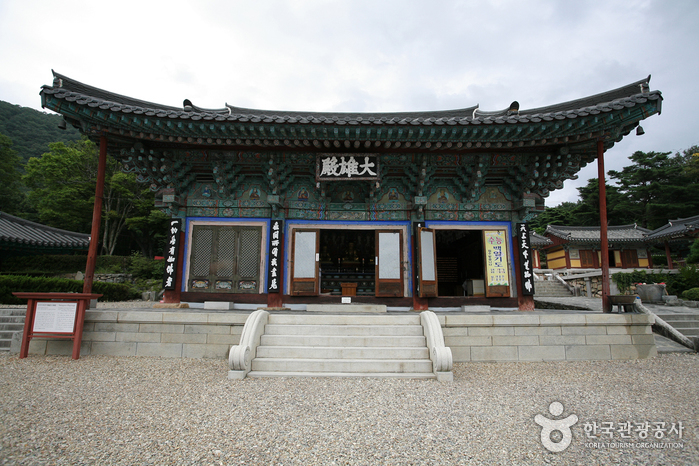
The path to Bogyeongsa smelled of damp earth and old wood. Temple roofs appeared between trees in measured layers, their painted beams quiet but intricate, like a prayer that had learned patience.
Bogyeongsa, a thousand-year-old Buddhist temple associated with Bulguksa Temple, was founded in the early seventh century during the Silla period. Its origin story carries the texture of legend: a sacred eight-sided mirror, buried beneath a pond near Naeyeon-san, and a temple built above it to protect the kingdom.
What stayed with me was not the grandeur, but the restraint. The courtyards did not demand awe. They invited it. A bell note drifted through the trees, and for a moment the whole mountain seemed to exhale.
Bogyeongsa (a thousand-year Buddhist temple) sits beneath Naeyeonsan in northern Pohang, where forest paths, old halls, and the story of an eight-sided sacred mirror gather in one quiet valley. Founded in the early 600s, the temple preserves major Buddhist halls, an old five-story stone pagoda, eight designated treasures, and a historic trifoliate orange tree.
The place feels cool and steady, with incense, stone, pine shade, and mountain water softening the noise of the coast. It is less a sightseeing stop than a slow exhale.
Admission is free, and parking and restrooms are available. For hikers, the ridge-valley-summit route links Bogyeongsa, Munsuam, Naeyeonsan, Hyangnobong, Simyeongni, and back to Bogyeongsa over 20 km.
Cold mist touched my face before I saw the water. Beyond Bogyeongsa, the trail toward the twelve waterfalls loosened the pace of the day; conversations softened, footsteps slowed, and the rush of water grew from a murmur into a bright, steady roar.
This was the journey’s most memorable moment: standing near the falls with market salt still on my lips and temple incense still in my clothes. Pohang’s drama was not only in its ocean horizon. It was here too, in white water pouring through green stone, in the sudden coolness of shade, in the simple luxury of not needing to move quickly.
Healing is an overused word, but the place made a strong case for it. Nothing performed. Everything restored.
I left Pohang with the feeling that its best views are not always where the map first sends you. The sea may draw you in, but the cliffs, market tables, temple courtyards, and waterfalls are what linger.
Travel tips
Walk this story
Places in this story
3 places
Itinerary
1 day
Region
경북
Places you can import
3 places

Comments
See what other travelers are saying.
Sign in to leave a comment
You can sign in with Google, Kakao or Naver.