TRAVELER STORY · 경북
Written by AI from Korea Tourism Organization travel-course data. It is not a real visitor’s review, so check hours and travel times before you go.
A restorative journey through Juwangsan, Jungpyeong Solbat, and the quiet dignity of Sayang Seowon.
In Cheongsong, the mountains do not ask you to hurry; they teach you how to breathe again.
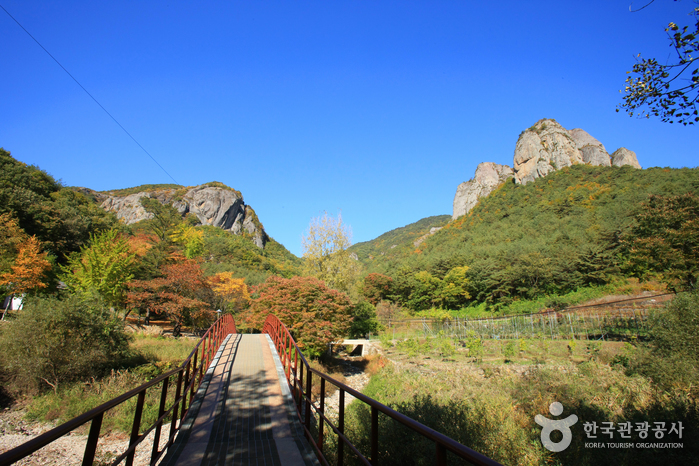
The air arrived first: cool, resinous, and edged with the mineral scent of stone after morning dew. I had come to Cheongsong chasing the silhouette of Juwangsan, a mountain whose ridges rise with the old authority of the Baekdudaegan, the great mountain backbone of the Korean Peninsula.
Walking here felt less like sightseeing than submitting to scale. The cliffs pulled the eye upward; the valleys gathered sound and softened it. Every bend in the trail seemed to trade noise for stillness, and by the time I reached the deeper folds of the landscape, the trip had already become what I had hoped for: a way back into my own body.
주왕산국립공원은 수백 미터 암봉이 병풍처럼 솟고, 주방계곡과 절골계곡 같은 깊은 물길이 이어지는 청송의 대표 자연 여행지입니다. 대전사와 암자, 폭포와 동굴까지 함께 둘러볼 수 있어 산세를 따라 걷는 동안 풍경의 결이 계속 바뀝니다.
바위 절벽 아래로 들어서면 계곡 물소리와 숲 냄새가 먼저 닿고, 고개를 들 때마다 암봉의 높이가 몸으로 느껴집니다. 산길은 웅장하지만 곳곳에 쉬어 갈 만한 여백이 있어 오래 머문 산의 기운이 남습니다.
상의탐방지원센터 일대에서 동선을 잡으면 계곡과 폭포, 대전사 주변 풍경을 함께 보기 좋습니다. 유모차 이용이 가능하고 장애인주차, 장애인화장실, 유모차 편의가 마련된 무장애 관광 요소도 있어 방문 전 이용 가능한 구간을 확인하면 좋습니다.
Jungpyeong Solbat (Jungpyeong Pine Grove) is a three-thousand-pyeong stand of old pines near the entrance of Jungpyeong-ri in Pacheon-myeon, Cheongsong. About 80 pine trees, some around 200 years old, gather here as a traditional biborim, a protective village forest believed to keep good energy within the settlement while offering shade and quiet to travelers.
The grove feels hushed and resin-scented, with tall trunks filtering the mountain light into soft green shade. Nearby Yongjeoncheon Stream adds the easy sound of water, making the place feel less like a stopover and more like a slow exhale.
Walk beneath the old pines first, then follow the setting toward Yongjeoncheon Stream, where campground facilities include tent decks and shower rooms. Pair the visit with Jungpyeong Seonbi Village, a slow-city hanok village with heritage houses such as the Pyeongsan Sin Clan Pansagongpa Head House, Seobyeok Historic House, and Sanam Historic House.
Sunlight fell in green-gold strips through the trunks at Jungpyeong Solbat, a 200-year-old pine grove near the entrance to Jungpyeong-ri village. The trees stood with the composed confidence of elders, their bark rough under the palm, their canopies breathing softly above the packed earth.
This was not just a pretty woodland. Jungpyeong Solbat is a classic bibo forest, a traditional protective grove believed to hold good energy inside a village and shield it from the outside gaze. Knowing that changed the way I moved through it. The forest felt designed for both spirit and privacy, a living threshold between the human settlement and the wider mountain world.
Nearby, the sound of Yongjeoncheon Stream gave the place a summer ease. I could imagine families setting up for a simple holiday, children searching the water for fish, and tired travelers lingering longer than planned because the shade here felt unusually generous.
A hush settled over Sayang Seowon, a Confucian academy tucked below Pilbong Peak in Jungpyeong-ri. The buildings did not shout for attention. They waited, low and dignified, carrying the quiet gravity of scholars, rituals, and names remembered across centuries.
Sayang Seowon honors Sin Hyeon, a civil official of the Goryeo dynasty, along with his son and the late Goryeo scholar Won Cheonseok. For an international traveler, the significance lies not only in the lineage but in the atmosphere: Korea's seowon were places where learning, moral cultivation, and ancestral reverence shared the same courtyard.
What stayed with me was the restraint. No theatrical grandeur. Just wood, slope, shadow, and the sense that history here had chosen a modest voice. Even the story of a plaque associated with Baekbeom Kim Gu, one of Korea's most revered independence leaders, seemed to deepen the silence rather than break it.
Sayang Seowon (a Confucian academy) rests below Pilbong Peak in Pacheon-myeon, Cheongsong, carrying the layered memory of Goryeo-era scholars and loyalists. Its story centers on Sin Hyeon, a respected scholar-official, alongside his son Sin Munhwon and Won Cheonseok, the late-Goryeo scholar remembered for refusing royal office out of loyalty.
The academy feels quiet and slightly withdrawn, with mountain air moving through old timber and open courtyards. Near the village entrance, a pine grove of about 80 trees, many around 200 years old, gives the approach a deep, resin-scented calm.
Follow the route from the pine grove toward the academy to feel how the landscape frames the site before the buildings appear. Look for the history tied to Hwahesa, whose name plaque is said to have been written by Kim Gu, and take time to absorb the academy as part of Cheongsong’s mountain-healing scenery.
By late afternoon, the mountains looked darker and closer, as if Cheongsong had folded the day inward. The journey had begun with a desire for healing, but it ended with something more precise: the comfort of places that do not perform for visitors.
Juwangsan gave the drama, Jungpyeong Solbat gave the shade, and Sayang Seowon gave the pause. Together they revealed a Cheongsong shaped by ridges, memory, and a kind of beauty that asks you to slow down before it reveals itself.
Cheongsong left me with the feeling of having walked through a landscape that protects its quiet fiercely. Long after leaving, I could still smell pine resin and hear the softened rush of water below the trees.
Travel tips
Walk this story
Places in this story
3 places
Itinerary
1 day
Region
경북
Places you can import
3 places

Comments
See what other travelers are saying.
Sign in to leave a comment
You can sign in with Google, Kakao or Naver.