TRAVELER STORY · 경북
Written by AI from Korea Tourism Organization travel-course data. It is not a real visitor’s review, so check hours and travel times before you go.
A quiet journey through Daeseungsa Temple and Korea’s first rail bike route.
In Mungyeong, beauty does not announce itself loudly; it waits in weathered paint, temple eaves, and the slow rhythm of wheels on an old coal railway.
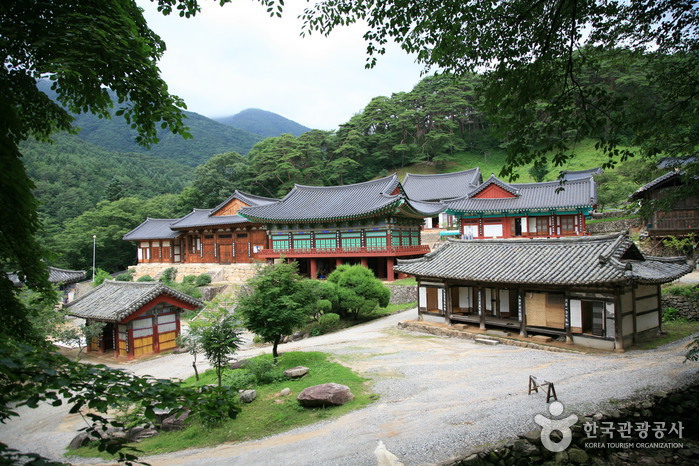
The air grew quieter before I even reached Daeseungsa Temple, a thousand-year-old Buddhist temple on Sabulsan Mountain. The road seemed to narrow into itself, drawing me away from schedules and screens and into the hush of old stone, timber, and mountain shade.
I had come to Mungyeong looking for an older kind of Korea, not polished or staged, but worn in the way a beloved object is worn. Daeseungsa gave it to me immediately. The stone terrace below Daeungjeon, the temple’s main Buddha hall, held lotus carvings with a calm, almost breathing elegance. Above me, under the eaves, fish, dragons, and floral latticework appeared in flashes as my eyes adjusted to the details.
Daeseungsa Temple in Mungyeong is a mountain temple set around 600 meters above sea level, carrying scars of fire, restoration, and centuries of Buddhist devotion. Look closely at the stonework near Daeungjeon Hall, the lotus details, fish and dragon motifs under the eaves, and the weathered dancheong, traditional painted temple decoration, where time feels almost tangible.
The temple feels quiet and aged in the best way: wind through the high forest, faded colors on old wood, and the hush of a place rebuilt more than once. Its beauty is not polished; it is worn, patient, and deeply Korean.
Follow the temple grounds slowly, then seek out references to Sabul Mountain and the four-sided stone Buddha connected to the Samguk Yusa legend. Daeseungsa Temple also operates a temple stay with tea conversation, Buddhist services, walks to Yunpilam Hermitage, Myojeogam Hermitage, and the four-sided stone Buddha, with participation arranged by personal choice.
Mungyeong Rail Bike turns a former coal railway into an easy outdoor ride through one of Mungyeong's most scenic corridors. The track follows the Yeonggang riverside and the Jinamgyoban area, often named among Mungyeong's finest views, with mountain ridges, river air, and old industrial traces passing slowly beside the rails.
The mood is light, breezy, and gently nostalgic: steel rails underfoot, cool wind on your face, and the quiet thrill of pedaling through a landscape once used for hauling coal.
Choose from routes including Jinnam Station to Gurang-ri, 3.6 km one way and 7.2 km round trip, or Gurang-ri Station to Meokbaengi, 3.3 km one way and 6.6 km round trip. Pets are allowed, and the ride is also known as a filming location from Queen of Tears, especially around the castle-like Gurang-ri Station area.
The faded dancheong, traditional painted decoration on Korean wooden buildings, smelled faintly of age and sun-warmed wood. Its colors had softened, not vanished. That was what made it beautiful. Nothing here begged to be restored into brightness; the temple seemed to trust time as part of its design.
Daeseungsa has survived fire, rebuilding, and centuries of devotion. It was repaired in 1644 and 1722, rebuilt again in 1831, then restored after major fires in 1922 and 1956. Knowing this changed the way I looked at the halls. The surviving and restored structures did not feel like museum pieces. They felt resilient.
The most memorable moment came when I thought about the legend of the four-sided stone Buddha on Sabulsan Mountain. According to Samguk Yusa, a silk bundle fell onto the mountainside in 587 during the Silla Kingdom, revealing a rock carved with Buddha images on all four sides. Whether read as history, faith, or poetry, the story made the mountain feel charged with possibility.
Metal clicked beneath my feet, and the rail bike began to move with a steady, satisfying rhythm. Mungyeong Rail Bike runs on tracks that once carried coal about 20 years ago, a remnant of an industry that shaped the region before giving way to a gentler kind of travel.
This was Korea’s first rail bike experience, and it still carries that sense of clever reinvention. The route rolls slowly along the Yeonggang River and past Jinnam Gyoban, considered the finest of the Eight Scenic Views of Mungyeong. The pleasure is simple: pedal, breathe, look up. Mountains fold around the rails, the breeze slides across your face, and the old railway turns from labor into leisure.
There are three round-trip route options: Jinnam Station to Gurangni, 7.2 km; Gurangni Station to Meokbaengi, 6.6 km; and Gaeun Station to Meokbaengi, 6.4 km. Each takes about 50 minutes to 1 hour, long enough for the landscape to loosen your shoulders.
By the time I left Mungyeong, the trip had settled into two different rhythms: the temple’s deep stillness and the rail bike’s gentle forward motion. One asked me to look closely at what endures. The other reminded me that places can change purpose without losing their soul.
Mungyeong does not overwhelm. It lingers. In the lotus stonework of Daeseungsa Temple, in the dragons beneath the eaves, in the old coal rails beside the river, I found a version of Korea shaped by patience, repair, and quiet grace.
Mungyeong stayed with me as a journey through time rather than a checklist of sights. Its beauty was not pristine; it was weathered, resilient, and deeply human.
Travel tips
Walk this story
Places in this story
2 places
Itinerary
1 day
Region
경북
Places you can import
2 places

Comments
See what other travelers are saying.
Sign in to leave a comment
You can sign in with Google, Kakao or Naver.