TRAVELER STORY · 경기
Written by AI from Korea Tourism Organization travel-course data. It is not a real visitor’s review, so check hours and travel times before you go.
A peace journey through Paju, where old tracks, river wind, and mountain bridges turn division into something felt underfoot.
On the Gyeongui Line, the rails seem to travel farther than the train itself, carrying a quiet dream of crossing borders that still hold.
The train doors opened to a wash of river air, cool against my face, and for a moment Imjingang Station felt less like an endpoint than a held breath. The Gyeongui Line once linked Seoul with Sinuiju, with freight trains later running as far as the Gaeseong Industrial Complex. Today, commuter trains reach Munsan, and since Mar 2020 a shuttle has continued between Munsan Station and Imjingang Station, twice on weekdays and four times on weekends.
I had come because the idea was irresistible: to ride north by rail and imagine, however briefly, a future journey through Gaeseong and onward to Pyongyang. The landscape did not announce itself with drama. It worked more subtly. Tracks, platforms, signs, the wide sky over the Imjin River. Everything seemed to point somewhere I could not yet go.
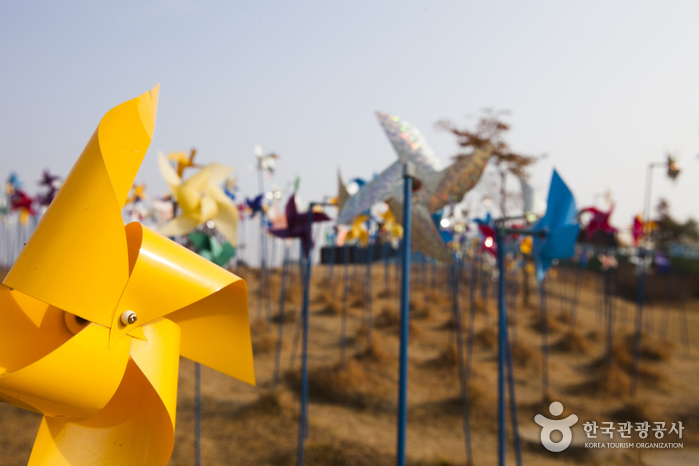
Paju Imjingak (Pyeonghwa Nuri Park, a peace-themed riverside park) gathers war memorials, exhibition spaces, the Peace Gondola, and traces of the Gyeongui Line in one vast outdoor site. A train that once ran toward Sinuiju stands here as a stark reminder of routes interrupted by the Korean War and national division.
The place carries the metal chill of old rail tracks, the open sweep of the Imjin River, and the ache of families who once bowed toward the north at Mangbaedan Altar. Even its photo spots feel layered with longing rather than spectacle.
Follow the route from the war memorials to the displayed train, Imjin Railway Bridge remains, Pyeonghwa Nuri Park, and nearby photo points such as Dokgae Bridge Skywalk. The site supports stroller use and barrier-free travel, with accessible parking, approach paths, entrances, restrooms, and stroller access.
Metal, stone, and grass caught the pale light around Imjingak Pyeonghwa Nuri Park, a major peace tourism site beside Imjingang Station. It is a place where history feels unusually close to the skin. Memorials for the Korean War stand across the grounds, including monuments connected to the Imjin River battle area and to American forces who served here.
The most haunting sight was the old train displayed on site, a reminder of the days before the Korean War when rail service ran north toward Sinuiju. Nearby, the Imjin Railway Bridge tells its own broken story: one of the two bridges was destroyed during the war, leaving only the piers behind. At Mangbaedan, displaced families have long bowed toward their ancestral homes in the North, turning private grief into a public ritual of remembrance.
Yet Imjingak is not frozen in sorrow. Families moved between exhibition spaces and open lawns; cameras clicked near the Dokgae Bridge Skywalk, opened in 2017; the breeze moved across Pyeonghwa Nuri Park with surprising softness. The place carries pain, but it also insists on the possibility of reunion.
The sound of a carousel rose lightly over the park, bright and almost startling after the weight of the memorials. Pyeonghwa Land, a small amusement park within the Imjingak tourist area, brings a strange and memorable contrast to the borderland mood: trains, bumper cars, a Viking ship, a carousel, a haunted house, and other rides gathered near one of Korea's most symbolic peace sites.
By day, children leaned toward the next attraction with the single-minded joy of a weekend outing. After dark, the park is known for its night views, when ride lights sharpen against the open sky. It did not erase the history around it. Instead, it made the place feel lived in. Peace here was not an abstract slogan; it looked like families eating snacks, teenagers posing for photos, and grandparents watching from benches.
Pyeonghwa Land operates Apr-Oct from 11:00-18:00 on weekdays and 11:00-18:40 on weekends; in Mar and Nov, weekday hours are 11:00-17:30. Facilities may vary, so check details before setting out.
Pyeonghwa Land is an outdoor theme park inside Imjingak Tourist Area in Paju, close to Pyeonghwa Nuri Park. Its rides range from a train, Viking ship, bumper cars, carousel, and haunted house to coin-operated safari, rider, and arcade facilities, making it a bright family stop along a route shaped by railways, borders, and hopes of reunification.
The place carries the cheerful clatter of ride tracks and ticket booths against the wider hush of Imjingang River country. By evening, the lights turn the park into a small carnival glow beside one of Korea's most symbolic peace-travel landscapes.
Pair the rides with nearby Imjingak sights such as Pyeonghwa Nuri Park, Pyeonghwa Gondola, Nuriseong Adventure Playground, and Supul Nuri. Facilities include restrooms, attractions, coin-operated machines, an unmanned convenience store, ticket office, office, first-aid room, broadcast room, and lost-child protection area.
Gamak Mountain Suspension Bridge marks the dramatic gateway to the Gamak Mountain trail in Paju, linking the cut edges of the Seolmari valley above Seolma Stream. The towerless mountain suspension bridge frames a rugged landscape of dark rock, pocket-sized valleys, and the nearby Ungye Waterfall, with the wider peace-travel route carrying thoughts toward Imjingang, Gaeseong, and beyond.
The bridge gives the mountain a pulse: cables hum in the wind, footsteps ripple underfoot, and the valley opens below in flashes of stone, water, and forest. It feels less like a lookout than a brief crossing between borderland history and raw mountain air.
Start at the bridge at the entrance to the Gamak Mountain Dulle-gil trail, then continue toward Ungye Waterfall or deeper hiking routes if time allows. Admission is free, parking is available, and pets are allowed, making it an easy outdoor stop on a Paju peace-travel itinerary.
The bridge trembled beneath my shoes before I had taken ten steps. At Gamaksan Chulleongdari, the suspension bridge at the entrance to the Gamaksan Dulle-gil trail, the Seolmari valley opens below in a clean drop of rock, stream, and air. The bridge links a valley divided by road, a practical crossing transformed into a small act of courage.
Gamaksan, one of the five noted mountains of Gyeonggi-do, takes its name from dark blue-black rock. From the bridge, the mountain did not feel severe so much as watchful. Below, Seolma Stream threads through a compact valley, and nearby Ungye Falls is known for its nearly vertical drop. Farther up the mountain are stories of Gamaksanbi, a stone monument near the summit, and Im Kkeok-jeong Cave, associated with the legendary outlaw said to have hidden from officials there.
It was not the same mood as Imjingak. The mountain offered movement after memory, a way to let the body carry what the mind had been holding. The bridge shook, the valley opened, and the day widened.
On the way back, the railway stayed with me more than any single photograph. Paju's peace route is not a simple itinerary of scenic stops. It is a layered journey through absence and hope: a station that suggests an unfinished map, a park where separated families are remembered, an amusement park glowing beside memorials, and a mountain bridge that asks you to trust the next step.
I left with the odd feeling that I had traveled both very little and very far. The train did not take me to Pyongyang. Not yet. But it made the dream feel less like a headline and more like a direction.
This trip lingers because it never turns history into a museum case. It lets you feel the border as wind, rail, silence, laughter, and the small courage of crossing a bridge.
Travel tips
Walk this story
Places in this story
3 places
Itinerary
1 day
Region
경기
Places you can import
3 places

Comments
See what other travelers are saying.
Sign in to leave a comment
You can sign in with Google, Kakao or Naver.