TRAVELER STORY · 경북
Written by AI from Korea Tourism Organization travel-course data. It is not a real visitor’s review, so check hours and travel times before you go.
A journey through pavilions, fortress stones, caves, and cliffside temples in Gumi.
On Geumosan, history does not sit behind glass; it rises in stone steps, cliff wind, and the old hush of a mountain that seems to remember everything.
The path begins with the clean scent of trees and the upright rhythm of metasequoias drawing the eye toward Geumosan Provincial Park, a 976-meter mountain in Gumi whose name is tied to a vision of a golden crow flying through the evening glow.
I came looking for that image: not a literal bird, but the feeling of it. Geumosan is no soft green hill. Much of the mountain is rock, broken into steep slopes and strange cliffs, and even before the climb begins, it carries the presence of somewhere older than a simple day hike.
The park is open at all times and has free admission, which gives the approach a pleasing informality. You can arrive without ceremony, pass from the road into the trees, and feel the city loosen behind you.
Geumosan Provincial Park rises above Gumi as a 976-meter mountain of stone cliffs, steep ridges, and old legends tied to a golden crow at sunset. Trails lead past Chaemijeong Pavilion, Geumosan Fortress, Doseon Cave, Yaksaam Hermitage, and a rock-carved bodhisattva, while a cable car helps visitors reach the waterfall area without taking on the full climb.
The mountain feels rugged from the first steps: wooden decks, sharp rock faces, forest shade, and the sound of water gathering near Myeonggeum Falls. History sits close to the trail here, not as a museum label but as stone, stair, shrine, and weathered path.
Start near the lower park area in Gumi, pass the metasequoia-lined approach, then choose between a light walk toward the cable car and waterfall or a longer climb toward the historic sites near the summit. Admission is free, and the park has parking, restrooms, and Korean-language forest interpreter service.
Water murmurs beneath the stone bridge at Gumi Chaemijeong, and the sound makes the pavilion feel less like a monument than a place still being kept alive by the stream.
Chaemijeong is a pavilion built in 1768 to honor Yaeun Gil Jae, a late Goryeo scholar remembered for refusing office after the fall of his dynasty. His loyalty was not loud or theatrical. It was a withdrawal, a life lived according to principle when history had already turned the page.
Crossing into the precinct, I found the arrangement precise and restrained: the pavilion on one side, Guinjae facing it, and behind them spaces connected to royal remembrance. The name Chaemi refers to an old Chinese story of loyal subjects surviving on gathered bracken rather than serving a new ruler. It is a compact story, but standing there, it felt expansive.
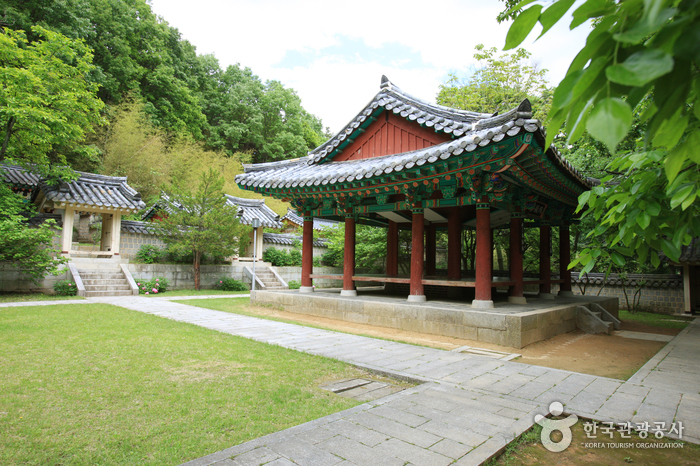
Gumi Chaemijeong Pavilion honors Yaeun Gil Jae, a late Goryeo scholar remembered for refusing office after the dynasty fell. Built in 1768, the pavilion sits beyond a stone bridge and Heunggi Gate, with Guin-jae Hall facing it and memorial structures behind that preserve the story of his loyalty.
The sound of the mountain stream meets old timber floors, tiled roofs, and the green edge of Geumosan. It feels less like a monument than a pause in the valley, where scholarship, refusal, and landscape share the same air.
Cross the stone bridge first, then pass through Heunggi Gate to read the layout: Chaemijeong Pavilion on one side, Guin-jae Hall opposite, and Gyeongmogak Shrine and the memorial stele pavilion behind. Look closely at the unusual Yeongnam-region floor plan, with an ondol-heated room at the center and wooden maru floors opening around it.
The mountain air sharpens as the trail rises, and the stones of Geumosan Fortress seem to emerge from the slope as if they grew there.
Geumosan Fortress was built around the summit and valleys in double layers of stone walls. Its exact beginnings remain uncertain, but the place is tied to a period when inland communities sought protection from Japanese raiders, and later to the Imjin War, the late 16th-century Japanese invasions of Korea. The source history names General Jeong Gi-ryong as one of the figures associated with defending this mountain.
What struck me was not the drama of battle but the practicality of fear: people from nearby towns retreating upward, storing grain and weapons, trusting the mountain's harshness to help them survive. The fortress makes Geumosan feel less like scenery and more like a shelter hardened by necessity.
Geumosan Fortress crowns and wraps the ravines of rugged Geumosan Mountain, a 976-meter peak inside Geumosan Provincial Park. Built as a double stone stronghold with inner and outer walls, it carries traces of wartime refuge, Joseon-era repairs, hidden gates, old building sites, and the long memory of the Imjin War.
The climb feels stony and watchful: cliff faces replace missing walls, wind moves through the mountain folds, and the remaining gate sites make the fortress feel less like a ruin than a lookout still holding its post.
Look for the remains of the inner and outer fortress gates, the ammun, a concealed small gate designed to evade enemies, and the monument believed to date from around 1868. Admission details are not provided; public restrooms are available on site.
Doseongul Cave is a natural cave on Geumosan Mountain, remembered as the place where Doseon, a Unified Silla monk associated with early Korean feng shui thought, is said to have reached enlightenment. Long admired from below before a passage was opened in 1937, the cave now rewards the climb with a wide view over the Nakdong River, the Gumi Industrial Complex, and distant Naengsan Mountain.
The path feels carved out of cliff and patience, with stone underfoot, mountain air in the lungs, and the sudden dark mouth of the cave holding centuries of pilgrim stories. From the opening, the landscape drops away in one broad, wind-bright sweep.
Look for the record left near the cave entrance after local residents and the Gumi township head opened the access route in 1937. After visiting the cave, continue a short way to Daehye Falls, where a 28m stream of water breaks the mountain silence with a cold, white roar.
Yaksaam Hermitage (Gumi) sits just below the summit of Geumosan, a 976-meter mountain tied to the legend of a golden crow in the sunset. The hermitage is said to date back to the Silla period, though its present halls are later constructions, with Yaksajeon Hall facing south beneath a wall of rugged stone.
The climb leaves the city sounds behind, and the hermitage appears against cliff faces, spring water, and mountain air sharpened by altitude. Inside Yaksajeon Hall, the seated Stone Medicine Buddha carries the weight of an old legend about three brother Buddha statues shining together.
Look for the rock-carved standing bodhisattva about 300 meters from the monks' residence, and pause by the eastern rock wall where mineral spring water emerges. Parking is available, but the final approach belongs to the mountain, so wear shoes suited for a summit route.
Cold rock presses close near Doseongul, and the entrance feels like a threshold between weather and silence.
Doseongul is a natural cave associated with Doseon, a Unified Silla monk known for introducing geomantic ideas to Korea. For a long time, the cave could reportedly only be seen from afar because there was no proper route to reach it. In 1937, local officials and villagers opened a passage, leaving a record near the cave entrance.
From the heights around the cave, the view drops away toward Gumi's industrial plain, the Nakdonggang River, and distant ridges. It is a startling contrast: factory lines and river water below, mountain stone at your shoulder, and a cave where monks and scholars once sought retreat.
Incense seems almost imaginable before it appears; Yaksuam Hermitage rests near the summit of Geumosan with cliffs rising around it like a protective wall.
Yaksuam, a Buddhist hermitage said to have origins in the Silla period, stands below rugged rock near the top of the mountain. Its central hall, Yaksajeon, enshrines a stone seated Bhaisajyaguru Buddha, the Medicine Buddha, connected in local tradition with two other related Buddha images on different mountains.
Near the hermitage, a bodhisattva figure is carved into rock. After the climb, that image stayed with me most: not grand in the way a palace is grand, but enduring. Geumosan gives its history in layers, and by the time I descended, the golden crow felt less like a legend than a way of seeing the mountain at last light.
Geumosan left me with the feeling of having climbed through several kinds of time: royal memory, wartime refuge, Buddhist retreat, and the private resolve of people who chose principle over ease. The mountain does not explain itself quickly, but it rewards attention.
Travel tips
Walk this story
Places in this story
5 places
Itinerary
1 day
Region
경북
Places you can import
5 places

Comments
See what other travelers are saying.
Sign in to leave a comment
You can sign in with Google, Kakao or Naver.