TRAVELER STORY · 울산
Written by AI from Korea Tourism Organization travel-course data. It is not a real visitor’s review, so check hours and travel times before you go.
A compact trip that tastes like grilled beef, feels like alpine wind, and ends under Busan's night skyline.
I came for a quick 2-day escape and found a route that moved from charcoal smoke to mountain air, then on to salt spray and harbor lights.
The first thing I noticed was the smell of charcoal and beef rising into the air before I even sat down at Eonyang Jinmi Bulgogi, a restaurant that has carried Eonyang's grilled-beef tradition since the 1960s. The meat came with the calm confidence of a place that knows exactly what it does best: eonyang bulgogi, thinly grilled beef made from quality Korean cattle, cooked without the heavy extras that often blur a good flavor.
I started the trip here because a road trip needs a strong opening. The meat was tender, savory, and clean on the tongue, and it set the tone for the rest of the day: deliberate, grounded, and quietly memorable. By the time I left, I felt less like I had eaten lunch and more like I had been officially welcomed into Ulsan.
Eonyang Jinmi Bulgogi (a heritage charcoal-grilled beef restaurant) stands in Ulsan's Eonyang area with a reputation built on decades of restraint and craft. Since its roots as a butcher shop in the 1960s, it has kept the spotlight on premium Korean beef, light seasoning, and the clean, smoky flavor of beef grilled over white charcoal. The result is a place that feels less like a casual meal stop and more like a living piece of local food history.
The setting feels open, unfussy, and warm with the steady rhythm of charcoal heat and sizzling beef. It has the easy confidence of a long-loved local institution, where families and road trippers can settle in without ceremony.
Order the signature eonyang bulgogi, thinly sliced beef seasoned to order and grilled over white charcoal for a sweet, clean first bite. It is child-friendly, and the restrained side dishes make the meat stand out rather than compete with it.
Set on the lower slopes of the Yeongnam Alps in Ulju-gun, Ulsan, the Yeongnam Alps Complex Welcome Center blends alpine scenery with a compact mix of culture and hands-on attractions. It is less a single stop than a small campus, with spaces that range from a cinema and mountain literature exhibits to climbing and family-friendly experience facilities.
The air feels sharper here, and the landscape gives the whole place a clean, open energy. It is the kind of stop where a quiet mountain backdrop can suddenly give way to a playful indoor activity or a burst of family chatter.
The best route is a short circuit through the Alps Cinema, the Bumbleman Experience Center, the International Climbing Gym, and the Mountain Literature Museum, with the Yeongnam Alps scenery tying everything together. The center is especially appealing for families, and each facility may keep its own schedule, so check the official website before you go.
Yoteutallae turns the Haeundae waterfront into a moving lookout. Step onto a modern catamaran and watch Busan shift from bright daytime water to sunset glow or neon night reflections, with Gwangalli and the open sea as the backdrop. It is a straightforward way to feel the city’s coastal energy without needing to plan a full day around it.
The mood is breezy, polished, and just theatrical enough to feel special. Wind, salt spray, and the skyline keep the ride alive from the first cast off to the last photo.
Choose a daytime cruise for clear views, a sunset tour for the most photogenic light, or a night tour for the harbor’s glittering skyline. Private party yachts are also available for groups who want to eat, fish, and linger on the water at their own pace.
Cold air and wide-open space greeted me at the Yeongnam Alps Complex Welcome Center, a nature-and-culture hub at the foot of the Yeongnam Alps. The landscape felt immediate and alive. I could hear children calling between the exhibits and feel the shift from city rhythm to mountain pace as the center unfolded into cinemas, experience spaces, and climbing facilities.
What stayed with me was the feeling of movement without hurry. This was not a place that asked me to stand still and admire nature from a distance; it invited me to step into it, play a little, and let the mountain atmosphere do the rest. I left with cool wind in my face and the sense that Ulsan had already done its part to slow me down.
Salt blew across the deck as the yacht skimmed over Busan's blue water, and for a moment the coastline felt private. At Yotteutallae, the sea looked polished under the afternoon light, then almost theatrical as sunset deepened over Haeundae and Gwangalli. The yacht ride made the city feel softer, as if Busan had lowered its voice and let me drift through the view.
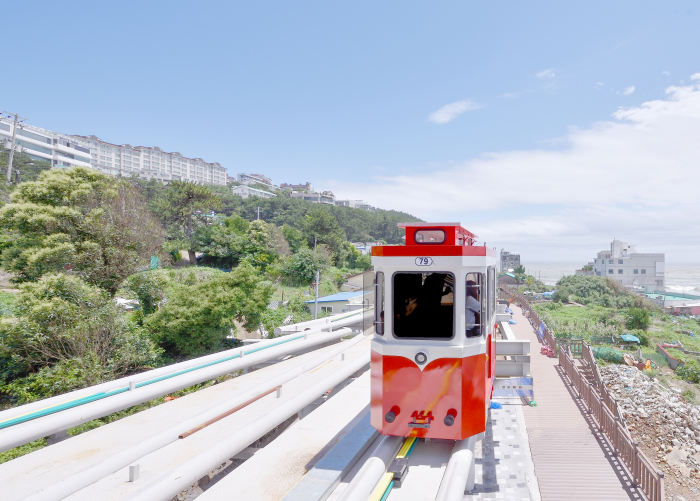
When night settled in, The Bay 101 turned the waterfront into a glittering frame for the skyline. Later, the Haeundae Blue Line Park Beach Train and Sky Capsule carried that feeling forward along the coast, gliding past the old rail line and open water. It was the kind of sequence that makes you keep looking out the window long after the scene has already changed.
Haeundae Blue Line Park transforms a 4.8 km stretch of the old Donghae Nambu Line into a slow coastal ride along Busan's eastern shoreline. The beach train runs from Mipo through Cheongsapo to Songjeong, while the Sky Capsule glides 7 to 10 meters above the tracks on a 2 km section between Mipo and Cheongsapo. This is a place built for looking outward, not hurrying through.
The mood is airy and cinematic, with sea wind, gull calls, and the low hum of the train pulling the shoreline into view frame by frame. It feels relaxed and slightly nostalgic, like a seaside memory set in motion.
Ride the beach train for the full coastal sweep, then stop at spots such as Mipo Station, Dalmaji Tunnel, Haewol Observatory, Cheongsapo Station, Daritdol Observatory, and Gudeokpo. The park is open year-round and pets are allowed, so it works well for a slow seaside outing with flexible stops.
Myeongran Brand Research Lab, a public-facing cafe and research space in Dong-gu, Busan, turns pollock roe into the day’s central flavor. The menu leans savory and briny, with myeongran oil pasta and myeongran risotto among the signatures, while the upper levels open toward Busan’s skyline and the North Port.
The mood feels airy and slightly elevated, with harbor wind, city light, and the hush of a viewpoint wrapped around a meal. It works best as a calm pause in a busy itinerary, especially for travelers who want scenery with their coffee.
The North Port view is the main reason to stop, and the setting feels especially rewarding in daylight or near sunset. The first floor is the only commercial area, while the rest of the building serves public-interest use; it is also child-friendly and has restrooms.
Choryang Ibagu-gil is one of Busan's clearest walks through urban memory, a hillside route that begins near Busan Station and climbs past traces of port trade, postwar shelter life, and old neighborhood landmarks. The path links narrow alleys, stairways, and viewpoints into a living archive, with the harbor appearing and disappearing as you move uphill.
The mood is quiet but layered, with the feeling of walking through several versions of the city at once. It is an outdoor route where history feels close, but the harbor breeze keeps the scene from ever becoming heavy.
Start near the former logistics-warehouse site opposite Busan Station, then follow the route past the old Baekje Hospital building, the Ibagu Gallery wall, the well site, the 168 Stairs, and Kim Min-bu Observatory, where the harbor view is especially strong. The course continues toward Mangyang-ro and ends at the Ibagu Workshop, so it works best as a slow uphill walk rather than a quick stop.
The stairways and old walls of Choryang Ibagu-gil sounded different from the sea front: shoes on stone, wind in the alleys, the hum of a district that has kept its memories rather than polishing them away. I walked from the Namseon Warehouse site toward the old Baekje Hospital building, past the Ibagu Gallery wall and the 168 Stairs, and the route felt like Busan was telling its own biography in chapters.
Before the walk, I stopped at the Myeongnan Brand Research Institute, where myeongnan oil pasta, pasta finished with pollock roe oil, and other roe-based dishes overlook Busan Port. It was an unexpectedly modern counterpoint to the old streets below. By the end, the trip felt complete: smoky, breezy, reflective, and alive with the kind of history you can hear under your feet.
By the end, I felt as if I had crossed a whole region in one breath: from smoky beef to mountain air, from salt spray to old harbor streets. Ulsan and Busan did not feel like separate stops anymore; they felt like one long, vivid memory.
Travel tips
Walk this story
Places in this story
6 places
Itinerary
2 days
Region
울산
Places you can import
6 places

Comments
See what other travelers are saying.
Sign in to leave a comment
You can sign in with Google, Kakao or Naver.