TRAVELER STORY · 경기
Written by AI from Korea Tourism Organization travel-course data. It is not a real visitor’s review, so check hours and travel times before you go.
Near Seoul, a borderland of lookout points, river cliffs, fall flowers, cold noodles, and quiet hanok courtyards.
In Yeoncheon, autumn does not soften history; it lays gold and crimson over it, and asks you to look closer.
The air sharpened as the road slipped north from Seoul, carrying that unmistakable Korean autumn smell: dry leaves, cool soil, and woodsmoke somewhere beyond the fields. I had come to Yeoncheon-gun for a trip that promised more than scenery. This was security tourism territory, a place where landscape and modern Korean history sit side by side without apology.
At Taepung Observatory, the mood changed. The view opened wide and silent from Suribong Peak in Jung-myeon, roughly 65 kilometers from Seoul and 140 kilometers from Pyongyang. The armistice line felt startlingly close: about 800 meters away, with a North Korean guard post about 1,600 meters beyond. Binoculars, fences, military presence, wind. Everything made distance feel measurable and unreal at once.
Taepung Observatory was built on Dec 3, 1991 by the Taepung military unit, and it remains one of the closest public-facing observatories to North Korea along the 155-mile armistice line. Visits require advance application 7 days before, and identification must be presented at the checkpoint after approval. Operating hours are 09:00-16:00, by time slot, excluding 12:00-13:00.
Taepung Observatory stands on Suribong Peak in Jung-myeon, Yeoncheon, about 65 km from Seoul and roughly 140 km from Pyongyang. Built by the Taepung Unit on Dec 3, 1991, it is known as one of the closest observatories to North Korea along the 155-mile armistice line, with the Military Demarcation Line about 800 m away and a North Korean guard post about 1,600 m beyond.
The air feels stark and watchful here, with autumn wind moving across the ridge and history sitting very close to the horizon. Memorial stones, military traces, and quiet religious spaces give the overlook a solemn, restrained weight.
Look for the memorials around the observatory, including the Manghyangbi monument for displaced people, Korean War monuments, and the memorial for young tank soldiers who served in the Korean War. The exhibition room displays everyday North Korean items recovered near Pilseung Bridge on the Imjin River, about 2 km away, along with infiltration equipment used by armed agents after the armistice.
Red and rust-colored autumn flowers blurred along the Imjin River, their softness almost defiant against the harder lines of fences, roads, and history. At Imjin River Kochia Park, the season felt theatrical: rounded kochia plants glowing like embers, the kind of color that makes travelers lower their voices without knowing why.
The road toward the Imjin River columnar joints brought another texture entirely. Stone rose in clean, geometric rhythms, shaped by time rather than politics. After the observatory, these cliffs felt like a reminder that the land has its own deeper calendar.
Later, at Yeongang Gallery, I found the trip's quieter register. The gallery gave the border region another language: not just maps and dates, but images, memory, and reflection. Yeoncheon does not let history stay abstract. It puts it in the wind, the river, the stone, and then sends you onward.
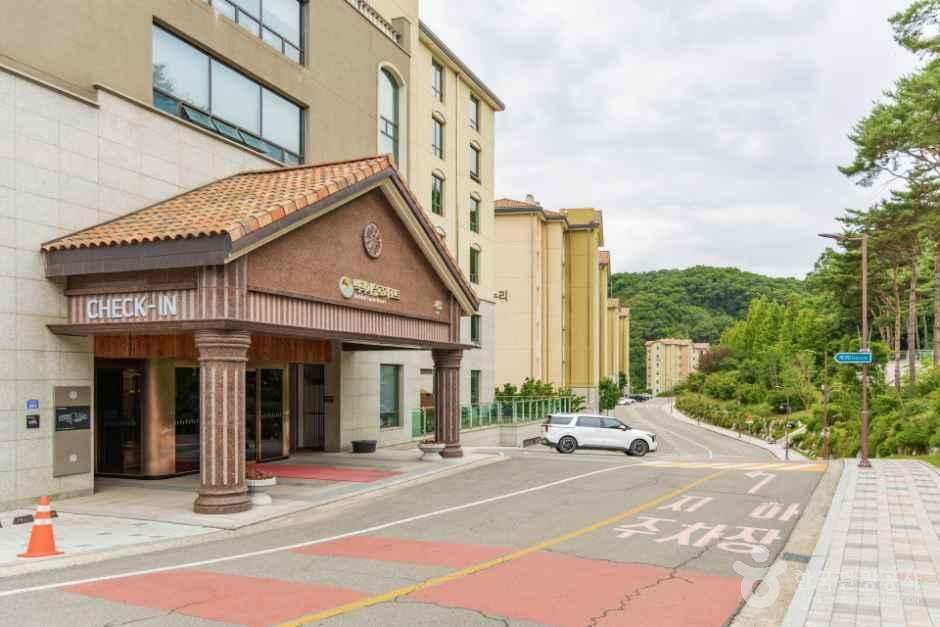
Evening settled over Baekhak Jayuro Resort with the clean, grassy scent of a golf course after sunset. The resort sits in Baekhak-myeon, surrounded by open air and the sort of northern Gyeonggi-do quiet that arrives quickly after dark.
From the room, the view stretched over green fairways, a strangely soothing contrast to the day’s military checkpoints and border stories. The resort has 145 condominium-style rooms along with seminar and banquet facilities, but what stayed with me was simpler: space, stillness, and the feeling of being allowed to exhale.
The next morning, I passed Yeoncheon Horogoru, an ancient riverside fortress site tied to the strategic movements of earlier Korean kingdoms. Here, the scale of Yeoncheon expanded. The border was not only a modern wound; this river corridor had mattered for centuries.
Inside Yeoncheon Gorangpogu History Park, voices from the past seemed to rise from the old ferry crossing. Once a strategic transport hub from the Three Kingdoms period onward, Gorangpogu later flourished through trade between Gaeseong and Hanseong in the 1930s, enough to host a branch of Hwashin Department Store. War and division changed its fate.
The park recreates that layered story with immersive history and security-themed experiences using virtual and augmented reality. It is also an accessible tourism site, with accessible parking, entrances, elevators, restrooms, and public transport access. Operating hours are 10:00-18:00, with last admission at 17:00.
Lunch at Manghyang Bibim Guksu Main Branch snapped everything awake. Bibim guksu, spicy mixed noodles, arrived bright, cold, and bracing, made here with more than ten fresh vegetables, bedrock water, and medium-thick noodles rather than the thinner somyeon often used elsewhere. The restaurant began in 1968 in front of a military unit in Gungpyeong-ri and has since grown into a nationwide chain. Pets are allowed only in designated areas.
By afternoon, Serabi Hanok Cafe slowed the pace again. The entrance alone felt ceremonial: some 1,800 enormous jangdokdae, traditional earthenware fermentation jars, lined the way before a long stairway led to a grand gate and a graceful hanok, a traditional Korean wooden house. In the courtyard, dessert and coffee tasted better for the silence around them.
Yeoncheon Gorangpogu History Park traces the story of Gorangpogu, a once-busy Imjin River ferry point that moved goods and people from the Three Kingdoms era through the 1930s. The park recreates the port’s layered past, from trade with Gaeseong and Hanseong to the scars of the Korean War, national division, and the Jan 21 armed infiltration route, with vivid historical and security-themed exhibits.
The mood is quiet but charged, with the open air of the riverside meeting the weight of borderland history. It feels less like a display case and more like a place where vanished traffic, old markets, and uneasy modern memory still linger.
Follow the recreated Gorangpogu scenes, then spend time with the virtual and augmented-reality history and security experiences. The site supports barrier-free travel with accessible parking, entrance access, elevator, accessible restroom, and public-transport access.
Baekhak Jayuro Resort is a countryside resort in Baekhak-myeon, Yeoncheon, set among clean air, open fairway views, and quiet northern Gyeonggi landscapes. With 145 condominium-style rooms plus seminar and banquet facilities, it works as a restful overnight base between Yeoncheon's history sites, autumn flower fields, and riverside scenery.
The mood is calm and spacious, with the green sweep of the golf course softening the edge of a long travel day. After the wind and open skies of Yeoncheon, the resort feels like a slow exhale.
Use Baekhak Jayuro Resort as the overnight pause on a 2-day Yeoncheon autumn route after stops such as Taepung Observatory, Yeongang Gallery, Imjingang Kochia Park, and the Imjingang columnar joints. Ask on site about current facility access, dining options, and any seasonal resort programs before settling in.
Manghyang Bibim Guksu Main Branch is a long-running noodle stop near Jeongok Station, first opened in 1968 in front of a military base in Gungpyeong-ri. Its signature bibim guksu, spicy mixed noodles, uses more than ten fresh vegetables, mineral-rich bedrock water, and chewy medium-thick noodles instead of standard thin somyeon.
The mood is casual, bright, and appetite-first, with the sharp scent of spicy sauce meeting the open-air ease of a countryside road-trip meal. It feels like the kind of place where travelers reset between history sites, autumn flower fields, and the basalt drama of the Hantangang River area.
Come hungry and focus on the bibim guksu, spicy mixed noodles, before continuing toward nearby stops such as Jaein Falls and Hantangang Flood Control Dam. Families can visit with children, restrooms are available, and pets are allowed only in designated areas.
Seravi Hanok Cafe is a graceful hanok-style cafe near the boundary of Gunnam-myeon and Jung-myeon in Yeoncheon. Set within Yeoncheon Miracle Town, its grounds include ecological wetlands, bunker houses, a swimming pool, and an unforgettable approach lined with 1,800 massive jangdokdae, traditional earthenware jars.
The climb past the jars and through the tall gate slows the day down before the first sip. In the front yard or inside the wooden hanok rooms, the mood feels hushed, old-fashioned, and quietly restorative.
Pause at the jangdokdae entrance before heading up the long stairs; it is the cafe’s strongest visual moment. The setting is child-friendly, and it works well as a soft rest stop after Yeoncheon’s autumn flower parks, historic sites, and riverside scenery.
임진강 주상절리는 임진강과 한탄강이 만나는 도감포 일대에서 북쪽으로 이어지는 현무암 절벽 지형입니다. 강물의 침식이 만들어낸 사각·육각형 돌기둥들이 병풍처럼 서 있고, 가을에는 담쟁이와 돌단풍이 절벽에 붉은 기운을 더합니다.
강가에 서면 바위 면을 따라 난 틈과 기둥의 결이 먼저 눈에 들어옵니다. 물소리와 바람 사이로 오래된 용암대지가 깎여 드러난 시간이 묵직하게 느껴집니다.
합수머리인 도감포 주변에서 강을 따라 펼쳐지는 절벽의 형태를 눈여겨보면 좋습니다. 가을에는 붉게 물든 절벽이 석양빛을 받아 ‘적벽’이라 불리는 장면을 만날 수 있습니다.
연천 호로고루는 임진강으로 이어지는 지류와 현무암 단애가 만든 지형 위에 자리한 고구려 평지성 유적입니다. 성벽 위에 오르면 28m 높이의 절벽 아래로 강줄기와 들판이 함께 펼쳐져, 연천의 역사와 지형을 한눈에 짚어보게 됩니다.
흙을 다져 올린 성벽과 검은 현무암 절벽이 맞닿아 있어, 오래된 방어선 위에 서 있다는 감각이 선명합니다. 바람이 성벽을 타고 지나갈 때마다 임진강 쪽 풍경이 더 넓게 느껴집니다.
동쪽벽은 가장 높은 부분이 10m에 이르며, 석성과 토성의 장점을 함께 보여주는 축성 방식이 눈에 띕니다. 해설사의 집에서 문화해설이 가능하니, 고구려 관방유적의 배경까지 듣고 둘러보면 동선이 훨씬 입체적으로 다가옵니다.
재인폭포는 한탄강 유네스코 세계지질공원 안에서 현무암 주상절리 절벽과 폭포를 함께 볼 수 있는 야외 관광지입니다. 지장봉에서 흘러온 물줄기가 높이 약 18m 절벽 아래로 떨어지고, 주변에서는 하식동굴과 포트홀, 가스튜브 같은 지질 흔적도 살펴볼 수 있습니다.
가을 코스의 끝에 서면 검은 현무암 절벽과 흰 물줄기가 한 화면에 들어옵니다. 폭포 아래 깊게 패인 물빛은 앞서 지나온 역사 여행과 꽃길의 분위기를 차분히 가라앉혀 줍니다.
전망 동선에서는 주상절리의 결, 폭포 아래 수심 5m에 이르는 포트홀, 절벽 주변 식생을 함께 보는 재미가 있습니다. 반려동물 동반이 가능하고 무장애 관광 정보가 마련되어 있어 장애인주차, 출입구, 장애인화장실, 대중교통 접근 정보를 확인해 방문하기 좋습니다.
At Jaein Falls, the sound came first: water striking rock with a steady, cleansing force. After two days of border views, old ferry routes, fiery flowers, noodles, and hanok shadows, the waterfall felt like Yeoncheon's final gesture.
I stood there longer than planned. Travel near a border can make every view feel weighted, yet Yeoncheon never felt grim. It was alert, beautiful, and quietly generous, a place where autumn color did not hide history but made it easier to approach.
Yeoncheon lingered as a journey of contrasts: military checkpoints and flower fields, cold noodles and ancient river roads, silence and falling water. I left with the sense that some landscapes are not just visited; they are listened to.
Travel tips
Walk this story
Places in this story
8 places
Itinerary
2 days
Region
경기
Places you can import
8 places

Comments
See what other travelers are saying.
Sign in to leave a comment
You can sign in with Google, Kakao or Naver.