TRAVELER STORY · 전남
Written by AI from Korea Tourism Organization travel-course data. It is not a real visitor’s review, so check hours and travel times before you go.
Cable cars, hillside views, and a harbor city that glows long after sunset.
Mokpo felt like a city that never dimmed, where the sea stayed bright by day and the shoreline turned cinematic after dark.
The first thing I noticed was the wind. It came off the sea with a clean, briny edge, and it seemed to sharpen every view in Mokpo. By the time I reached the old downtown and looked out toward the harbor, the city already felt wider than its map, as if it had opened itself to the water.
I had come for a short one-night, two-day trip, but Mokpo immediately made that feel too small. The plan was simple: follow the coastline, take in the big views, and let the city reveal itself from above before ending the day beside the lights of the waterfront.
The cable car lifted slowly, and then all at once the city dropped away. Below me, the harbor, the hills, and the islands spread out in layered blues and greens, with Mokpo's old downtown and Bukhang Harbor stretched like a living postcard. The Mokpo Maritime Cable Car is not just a ride; it feels like a long inhale, a suspended moment where the sea and land stop competing and simply belong together.
What stayed with me most was the height. The line rises over a dramatic distance, and the view keeps expanding until even familiar things feel newly arranged. As the cabin swayed gently, I kept turning from one window to another, trying to hold the whole scene at once: Yudalsan, the scattered islands of the Dadohae archipelago, and the bright geometry of the harbor below.
Mokpo Marine Cable Car sweeps above the old harbor, Yudalsan Mountain, and the island-studded Dadohae sea in one dramatic ride. At 3.23 km long and rising to 155 m, it turns the city’s coastline into a wide cinematic panorama, with sea, hills, and rooftops unfolding in every direction.
The mood shifts with the light: crisp and breezy by day, glittering and almost theatrical after dark. Suspended over the water, the ride feels both expansive and intimate, with Mokpo’s port energy humming below.
Ride the full route from Bukhang Station to Yudalsan Station and onward toward Gohado Station, then continue to the Gohado Observatory for another sea-facing viewpoint. Come for both daylight and evening if you can; this is one of the rare city attractions in Mokpo that delivers a distinctly different scene after sunset.
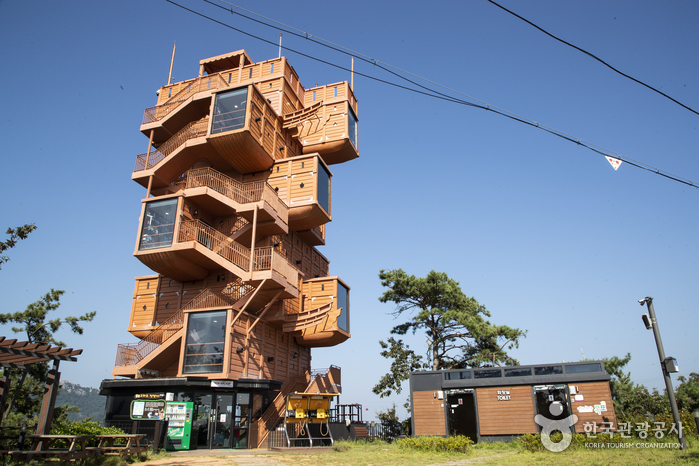
At Gohado Observatory, the air was quieter and the horizon felt closer. The building itself caught my attention first, with its striking form inspired by panokseon, the traditional Korean warships that once carried Admiral Yi Sun-sin into one of Korea's most celebrated victories. It is a place that looks outward, but it also looks inward, carrying memory in its structure.
Inside, the mood shifted from sightseeing to reflection. The upper floors opened onto the sea, and the exhibition spaces gave the trip a deeper texture. Standing there with the harbor light on my face, I could feel how Mokpo turns landscape into story. This was no ordinary viewpoint. It was a place where the view and the history seemed to speak to each other.
Gohado Observatory (a lookout and exhibition tower on Gohado Island) turns local history into architecture, stacking 13 Panokseon warship models into a striking grid-like structure. The site honors Admiral Yi Sun-sin, who regrouped here for 106 days after the Battle of Myeongnyang, while opening wide views over Mokpo's coastal waters. Inside, the first floor works as a rest area, and floors two through five combine observation decks with exhibits on Mokpo tourism.
The mood shifts between crisp sea air and quiet historical weight. From the upper levels, the water and islands spread out in broad, clean lines that make the whole stop feel both reflective and cinematic.
Start on the first-floor lounge, then move upward through the exhibition floors to the observatory for the best sequence of views. Use the accessible route if needed; the site supports barrier-free travel with disabled parking, approach paths, and Braille guide materials.
After sunset, the city changed temperature. The air cooled, the water darkened, and the waterfront began to shimmer with movement and light. The Dancing Sea Fountain brought the day to a close with a burst of color and sound, and the show felt like Mokpo's final flourish, playful and confident at once.
That last evening tied the whole trip together. The cable car had given me scale, the observatory had given me context, and the fountain gave me the kind of memory that lingers because it feels shared with everyone standing there. I left with the sense that Mokpo is best experienced as a sequence of scenes, each one brighter than the last.
Mokpo stayed with me as a city of motion and light, where sea views, history, and nighttime spectacle meet without effort. It is the kind of place that turns a short trip into a memory with depth and breeze in it.
Travel tips
Walk this story
Places in this story
2 places
Itinerary
2 days
Region
전남
Places you can import
2 places

Comments
See what other travelers are saying.
Sign in to leave a comment
You can sign in with Google, Kakao or Naver.