TRAVELER STORY · 충북
Written by AI from Korea Tourism Organization travel-course data. It is not a real visitor’s review, so check hours and travel times before you go.
A slow journey through Boeun, where mountain silence, temple incense, and fortress winds make daily life feel far away.
In Beopjusa, the forest sounds older than memory; by Samnyeonsanseong, even the stone walls seem to breathe out the patience of centuries.
The first thing I noticed at Beopjusa was the hush. Not complete silence, but the layered kind: leaves shifting overhead, a distant bell of wind through the trees, and the soft crunch of my steps as I moved deeper into the forested foothills of Songnisan. It felt like I had crossed an invisible line where ordinary time thinned out.
I had come looking for a break from the pressure of constant noise, and Beopjusa gave me exactly that. The temple sits comfortably beneath the mountain, and its old trees seem to hold the whole place in a steady, calming grip. I wandered without hurry, breathing in the cool air and the faint incense drifting from the temple grounds. The free admission made it easy to arrive with no agenda except to slow down.
속리산국립공원은 속리산과 화양, 선유, 쌍곡 계곡이 함께 어우러진 넓은 산악 공원입니다. 화강암 봉우리가 날카롭게 솟고 깊은 계곡이 파여 있어, 걷는 방향마다 바위 능선과 숲의 결이 다르게 보입니다. 법주사를 중심으로 천황봉, 문장대, 입석대 같은 산속 고적을 함께 만날 수 있습니다.
숲길에 들어서면 나무 그늘 사이로 산세가 겹겹이 드러나고, 계곡 물소리가 걸음의 속도를 늦춥니다. 오래된 절과 바위 봉우리가 한 풍경 안에 놓여 있어 세월이 층처럼 쌓인 느낌이 납니다.
법주사 일대를 중심으로 가볍게 둘러보거나, 천황봉·문장대 방향 등산 코스를 이어갈 수 있습니다. 산불예방 및 자연휴식년제로 통제되는 구간이 있을 수 있으니 출발 전 공원관리사무소에 확인하는 편이 좋습니다.
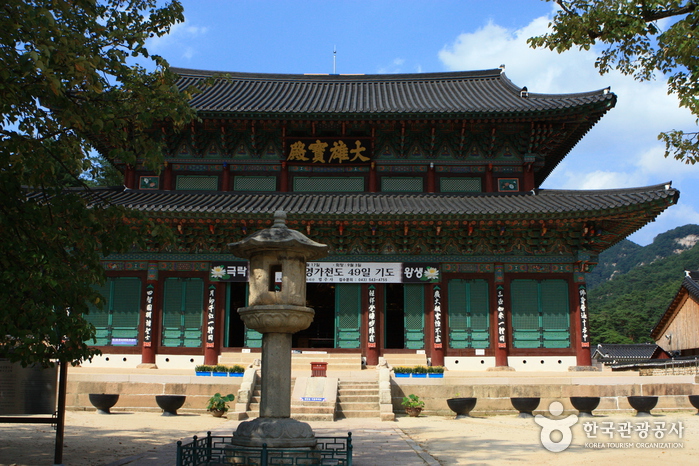
Beopjusa Temple, a UNESCO World Heritage site in the forested folds of Songnisan, carries more than a millennium of Buddhist history in its courtyards and halls. Its layered grounds lead from the iconic Palsangjeon wooden pagoda to larger temple buildings, stone relics, and quiet paths that slow every step.
The air feels hushed and shaded, with tall trees softening the edges of the temple complex and making the outside world seem far away. It is a place for unhurried walking, reflection, and the kind of silence that settles deep.
The most memorable stop is Palsangjeon, a five-story wooden pagoda central to Korean wooden-tower studies. If you visit in the warmer months, go early enough to enter before the 18:00 admission cutoff; the temple is free to enter, open year-round, and has parking on site. Temple stay programs are also offered for travelers who want a deeper Buddhist experience.
Boeun Samnyeonsanseong is a Silla-era mountain fortress in Boeun, North Chungcheong, built to command the ridgeline and guard a strategic pass through the hills. Its 1.7-kilometer stone walls rise in a rugged loop, and the craftsmanship of the cut stone becomes most striking when you stand below the ramparts and look up.
The fortress feels solemn without feeling heavy. Moss in the joints of the stone and the long view to the surrounding peaks turn a battlefield into a quiet place for walking and reflection.
From the parking area, it takes about 10 minutes uphill to reach the west gate entrance, where the walk truly begins. Follow the walls for the broadest views, and look for the rock face engraved with the calligraphy of Kim Saeng and the drained pond looking up at the sky; admission is free, and the site is open year-round.
The stone, wood, and forest all felt touched by age. Beopjusa, whose name means "the place where the Buddha's law remains," has stood here since 553, and that long history gives the grounds a weight you can feel in your chest. I found myself pausing again and again, not because there was a single dramatic monument demanding attention, but because everything seemed to ask for contemplation.
What stayed with me most was how naturally the temple blended into its surroundings. The mountain air was crisp, the shade deep, and the atmosphere quietly restorative. Go in early if you can, especially in the warmer months, and let the temple be more than a stop on an itinerary. Stay long enough for the place to settle into you.
The wind sharpened when I reached Samnyeonsanseong, and the mood changed at once. The fortress walls rose with a stern, confident presence, their stonework laid so precisely that the structure seemed less built than commanded into the landscape. Standing below the ramparts, I felt small in the best possible way.
This was where history stopped being abstract. The fortress has seen kings, retreats, and military encampments, and yet its greatest power today may be the way it restores perspective. I walked the 1.7-kilometer perimeter in patches, stopping to look out over Boeun and the surrounding hills. The air was clear, the path steady underfoot, and the whole place carried a feeling of endurance that made my own worries seem easier to set down.
By the time I thought about Seonbyeongguk House, the 99-room traditional mansion in Boeun, I was already in the right frame of mind to appreciate it. After the forest at Beopjusa and the disciplined strength of Samnyeonsanseong, the house felt like another lesson in Korean restraint: spacious, grounded, and shaped by a way of life that valued calm over display.
What I brought home was not a list of sights, but a quieter rhythm. This trip unfolded like a long exhale. It reminded me that healing does not always arrive with spectacle; sometimes it comes from walking among old trees, tracing stone walls, and letting centuries do the talking.
Boeun left me with the rare sense that time can be a comfort rather than a pressure. In the stillness of Beopjusa and the strength of Samnyeonsanseong, I found the kind of peace that lingers long after the trip is over.
Travel tips
Walk this story
Places in this story
3 places
Itinerary
1 day
Region
충북
Places you can import
3 places

Comments
See what other travelers are saying.
Sign in to leave a comment
You can sign in with Google, Kakao or Naver.